
- 5 min
Best SEBI Registered Investment Advisor in India (2026): Verify, Compare, and Choose Right

Written by
Kashish Manjani
- Blog
- Financial Planning
Date
06 August 2026
YouTube
Selecting the best SEBI registered investment advisor in India in 2026 requires clarity, not just visibility. With increasing regulatory oversight and more advisory firms entering the market, choosing the right SEBI registered investment advisor — or a SEBI registered financial advisor in Bangalore if you’d prefer someone you can meet in person — has become an important financial decision.
Fewer than 1,000 individuals in India currently hold a valid SEBI Registered Investment Adviser (RIA) license. That scarcity is exactly why verification matters more than marketing claims. This guide shows you what defines a high-quality RIA, how to verify one in under five minutes, and the questions that separate a genuine fiduciary from a salesperson in disguise.
If you’d rather skip the research and talk to a verified RIA directly, book a free Clarity Call with Aikeyam
What Is a SEBI Registered Investment Advisor (RIA)?
A SEBI registered investment advisor is an individual or firm authorized by the Securities and Exchange Board of India (SEBI), under the SEBI (Investment Advisers) Regulations, 2013, to provide personalized investment advice.
Many investors use the term SEBI registered financial advisor interchangeably with RIA, but under regulation, the formal designation is SEBI Registered Investment Advisor.
Unlike distributors who earn commissions from financial products, RIAs operate under a fiduciary obligation, meaning they must act in the client’s best interest — not the product manufacturer’s.
In 2026, a legitimate RIA must:
- Hold a valid, current SEBI registration number
- Comply with NISM certification requirements (NISM Series X-A and X-B)
- Follow SEBI’s prescribed fee caps
- Maintain documented risk profiling and suitability records
- Publish investor charter and grievance redressal disclosures on their website — see, for example, Aikeyam’s own Investor Charter and Complaints & Redressal pages
How to Verify a SEBI Registered Investment Advisor in 5 Minutes
This is the single most important step before engaging anyone — and the one most guides only describe instead of showing.
Step 1: Go to the official SEBI Intermediaries search page: sebi.gov.in/intermediaries.html
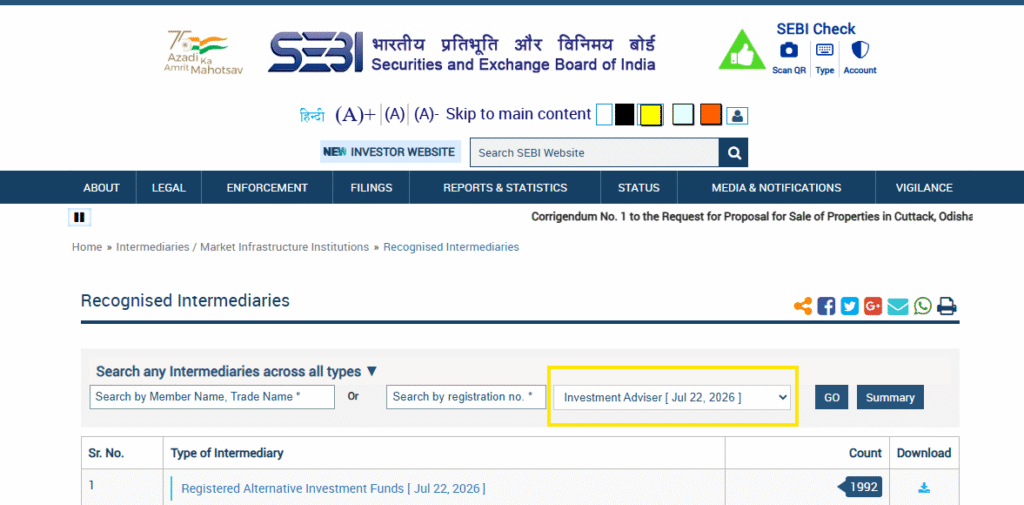
Step 2: Search by the advisor’s name, firm name, or registration number (format: INA0000XXXXX for individuals/non-individuals).

Step 3: Confirm these details match what the advisor gave you:
- Registration number and validity status (active vs. expired/cancelled)
- Registered email and phone number
- Correspondence/office address
- Type of registration (individual or non-individual)
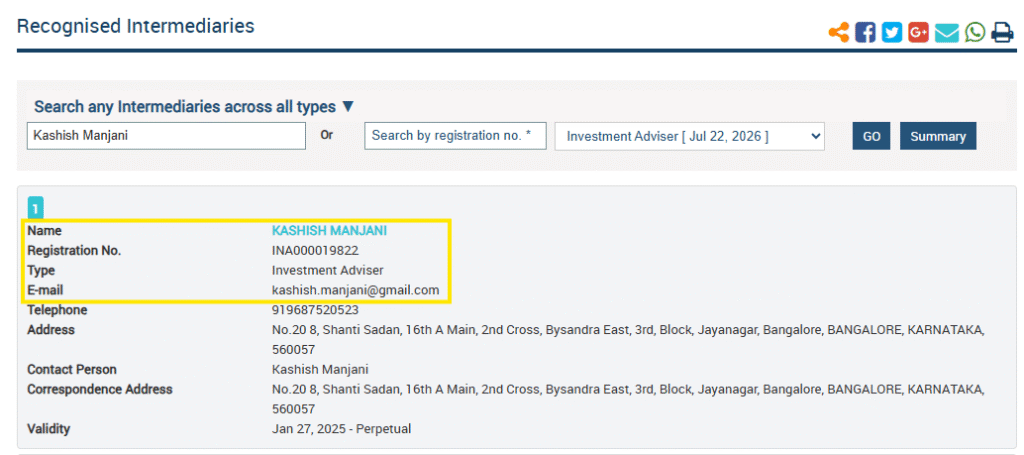
Step 4: If the advisor’s name doesn’t appear at all, or any detail doesn’t match, this is a hard stop, not a minor discrepancy.
Step 5: Ask the advisor to share their Investor Charter and grievance redressal policy link directly. A genuine RIA will have this published on their own website (SEBI mandates it) and will send it without hesitation.
Quick tip: Save a screenshot of the SEBI registry entry showing the registration as active on the date you engaged the advisor. It’s useful documentation if you ever need to raise a complaint through SCORES (SEBI Complaints Redress System).
Prefer a second opinion on an advisor you’re already considering? Talk to our team — we’re happy to help you interpret the registry details.
SEBI Registered RIA vs. Mutual Fund Distributor vs. Bank RM vs. Unregistered Tipster
| Criteria | SEBI Registered RIA | Mutual Fund Distributor (MFD) | Bank Relationship Manager | Unregistered Telegram/YouTube Tipster |
|---|---|---|---|---|
| Regulated by SEBI as an advisor | ✅ Yes | ❌ No (registered as distributor only) | Only if separately RIA-registered | ❌ No |
| Fiduciary duty to client | ✅ Yes, legally mandated | ❌ No | ❌ No, unless also RIA-registered | ❌ No |
| Earns commission from products | ❌ No — fee-only | ✅ Yes | Often yes | Untraceable / often undisclosed |
| Fee structure | Capped: ₹1,51,000/year flat or 2.5% AUA | Trail commission (varies by AMC) | Salary + product incentives | Usually opaque or subscription-based |
| Can guarantee returns | ❌ No — illegal to do so | ❌ No | ❌ No | ⚠️ Frequently claims to (a major red flag) |
| Grievance redressal via SEBI SCORES | ✅ Yes | Limited | Limited | ❌ None |
| Required risk profiling before advice | ✅ Yes, mandatory | Not mandatory | Not mandatory | ❌ Never done |
If you take one thing from this table: only the RIA column carries a legal fiduciary obligation. Everyone else may still be well-intentioned, but their compensation model is structurally tied to what they sell you, not what’s best for you.
What Defines the Best SEBI Registered Investment Advisor (RIA) in India?
There is no universal formula for identifying the best SEBI registered investment advisor, as suitability depends on your financial goals and risk profile. However, high-quality advisory firms tend to share these characteristics.
A Structured Advisory Process
Strong advisors follow a clear framework: understanding goals, assessing risk, building asset allocation, constructing portfolios, and reviewing them periodically. If recommendations begin with products instead of understanding your financial life, that’s a warning sign.
Transparent and Regulated Fees
SEBI regulates advisory fees under two models:
- Fixed-Fee Model: capped at ₹1,51,000 per year per family
- Assets Under Advice (AUA) Model: capped at 2.5% per year
A credible advisor explains upfront which model they use, how often you’re billed, and exactly what’s included.
Conflict-Minimized Advice
A fee-only RIA does not earn incentives from product manufacturers, which reduces structural conflicts and supports long-term alignment. Note: SEBI’s restriction applies specifically to SEBI-regulated products (mutual funds, stocks) — always ask about any ties to non-SEBI products like insurance.
Behavioral Discipline
Markets fluctuate, but investor behavior often determines outcomes. High-quality advisors add value by helping clients stay disciplined during volatility, avoiding panic selling or performance chasing.
Ongoing Review and Accountability
Financial plans must evolve with life events — career shifts, business growth, family changes, retirement. Advisors who follow structured review cadences tend to deliver more consistent long-term outcomes than those who deliver a one-time PDF and go quiet.
Curious how a structured review cadence actually works? See how Aikeyam approaches Financial Planning and Investment Planning & Management.
Red Flags: When to Walk Away From an "Advisor"
Watch for these warning signs, regardless of how polished the pitch sounds:
- Guaranteed or assured returns — no SEBI-registered entity can legally promise this
- Requests for POA (Power of Attorney) over your demat/trading account
- Pressure to pay via cash, personal UPI, or unofficial channels instead of the firm’s registered bank account
- No risk profiling before recommendations — advice given before your goals or risk appetite are understood
- Reluctance to share SEBI registration number or Investor Charter
- Only showing winning trades or cherry-picked performance, never a complete track record
- Urgency tactics (“offer ends today,” “limited slots”) on what should be a long-term relationship decision
Choosing a SEBI Registered Financial Advisor in Bangalore
If you’re specifically searching for a SEBI registered investment advisor in Bangalore or a SEBI registered financial advisor in Bangalore, a few additional considerations apply beyond the general checklist above:
- In-person accessibility matters for some investors, particularly around large decisions like retirement corpus planning, NRI investment structuring, or estate planning where a face-to-face conversation adds comfort.
- SEBI’s Bangalore local office (2nd Floor, Jeevan Mangal Building, No. 4, Residency Road, Bengaluru – 560025) handles regional grievance escalation, so a Bangalore-based advisor is also closer to that regulatory touchpoint if you ever need it.
- Verify the same way regardless of location — physical proximity does not substitute for checking SEBI registration, fee transparency, and process quality.
Aikeyam is based in Jayanagar, Bangalore, and works with both Bangalore-based clients and NRIs/professionals across India. Find us on Google Maps.
Choosing an Investment Advisor That Fits Your Financial Life
Choosing the right RIA isn’t about popularity — it’s about alignment.
Start by evaluating your own financial situation. Are you building wealth, managing surplus capital, planning retirement, or preserving assets? Different life stages require different advisory depth. If you’re an NRI, for instance, the considerations shift further — see our related guide on US NRI Financial Planning: Banking, Investments & Taxes Explained.
Next, assess whether the advisor’s process matches your expectations. Do they begin with goal setting and risk profiling, or move directly to product recommendations? A structured process often reflects long-term thinking.
It’s equally important to understand their communication style and review framework. Some investors prefer periodic detailed reviews; others value ongoing access and behavioral guidance during market volatility.
Finally, evaluate fee transparency and incentive structure. An advisor whose compensation model is clearly explained is more likely to maintain long-term trust.
The right RIA is one whose philosophy, process, and structure align with your financial journey — not simply one with the highest visibility.
Questions to Ask Before Hiring a SEBI Registered Investment Advisor (RIA)
Before signing an agreement, ask:
- What is your SEBI registration number, and can I verify it now?
- How exactly are you compensated — fixed fee, AUA, or otherwise?
- Do you or your firm receive any product-linked incentives, even outside SEBI-regulated products?
- What is your asset allocation philosophy, and how is it tailored to my goals?
- How often will my portfolio and plan be reviewed?
- How do you guide clients during market corrections — what does that conversation actually look like?
- Can I see a sample financial plan or review report (with client details redacted)?
The answers will reveal far more than online rankings or search results ever could.
The Aikeyam Perspective
At Aikeyam, a SEBI Registered Investment Advisor based in Jayanagar, Bangalore, advisory is structured around clarity and discipline rather than short-term performance narratives.
About the advisor: This article is written by Kashish Manjani, CFP®, CTEP, Principal Officer at Aikeyam. Kashish blends strategic thinking with timeless financial principles — helping clients grow, protect, and align their wealth with their values. Connect on LinkedIn, Instagram, or YouTube.
The process begins with defining financial goals, assessing risk tolerance, understanding cash flow stability, and building asset allocation before product selection. Operating under a fee-only, fiduciary-led framework, the emphasis remains on long-term wealth alignment rather than product promotion.
This approach suits investors — including NRIs and Bangalore-based professionals — who value structure, transparency, and steady compounding over reactive investing. Related reading: Mutual Funds vs Direct Equity: Which Builds Wealth Faster in India?
You can verify Aikeyam’s SEBI registration directly on the SEBI Intermediaries portal, or review our Investor Charter and Complaints & Redressal disclosures before reaching out.
Final Thoughts
The search for the best SEBI registered investment advisor in India in 2026 should begin with verification, not visibility.
A strong advisor offers regulatory credibility, transparent fees, structured planning, behavioral discipline, and long-term review support. Verify first. Compare fee structures second. Assess process and communication third. Choosing thoughtfully today can influence your financial outcomes for decades.
Written by
Kashish Manjani
Kashish blends strategic thinking with timeless financial principles — helping clients grow, protect, and align their wealth with their values. Kashish blends strategic thinking with timeless financial principles — helping clients grow, protect, and align their wealth with their values.
FAQs
Frequently Asked questions
Q1. How do I check if a SEBI registered investment advisor is genuine?
Verify any SEBI registered investment advisor by searching their name or registration number on the official SEBI Intermediaries portal. A genuine advisor will also provide NISM certification details, BASL membership, and a formal client agreement outlining fees and services.
Q2. Is it better to choose a fee-only SEBI registered financial advisor?
A fee-only SEBI registered financial advisor does not earn commissions from financial products, which reduces potential conflicts of interest. For investors seeking unbiased advice, this structure is generally preferred.
Q3. Can a SEBI-registered investment advisor guarantee returns?
No. A SEBI-registered investment advisor cannot legally guarantee returns. Investment outcomes depend on market performance, asset allocation, and investor discipline. Any advisor promising assured returns should be approached with caution and reported via SCORES.
Q4. How much does a SEBI-registered investment advisor charge in India?
SEBI caps advisory fees under two models: a flat fee of up to ₹1,51,000 per year per family, or an Assets Under Advice (AUA) fee of up to 2.5% per year. Always confirm which model applies and whether there are any additional charges.
Q5. What's the difference between a SEBI RIA and a mutual fund distributor?
An RIA is a fiduciary who charges fees directly to clients and cannot earn product commissions. A mutual fund distributor earns trail commissions from AMCs for the funds they sell, and is not held to the same fiduciary standard.
Q6. How many SEBI registered investment advisors are there in India?
An RIA is a fiduciary who charges fees directly to clients and cannot earn product commissions. A mutual fund distributor earns trail commissions from AMCs for the funds they sell, and is not held to the same fiduciary standard.
Q7. How do I choose the best SEBI registered investment advisor for my needs?
The best SEBI registered investment advisor for you depends on your financial goals, risk tolerance, and asset complexity. Look for a structured advisory process, transparent fees, verified regulatory compliance, and ongoing review support — not just search rankings.
Q8. Is Aikeyam a SEBI registered investment advisor in Bangalore?
Yes. Aikeyam operates as a SEBI Registered Investment Advisor based in Jayanagar, Bangalore, under a fee-only fiduciary model. Registration details can be verified directly on the SEBI Intermediaries portal, and disclosures are available on our Investor Charter page.
Figuring out your RNOR status does not need to involve guesswork or a spreadsheet full of travel dates. Whether you have just returned to India or are planning your move in the next year, running your numbers through Aikeyam’s RNOR calculator gives you a clear answer along with the specific years you can use the benefit, so you can plan your finances with actual figures instead of assumptions.