
Transfer, Diversify & Manage Your RSUs: Taxation, Diversification & Wealth Planning

Written by
Kashish Manjani
- Blog
- Financial Planning
Date
11 September 2026
YouTube
If you work at a large tech company, RSUs (Restricted Stock Units) are probably the single biggest line item on your balance sheet — bigger than your savings account, bigger than your mutual funds, sometimes bigger than everything else combined.
That’s exactly the problem.
RSUs are one of the best wealth-building tools a salaried employee can have. But left unmanaged, they quietly turn into the riskiest asset most people own — because the same company that pays your salary is also the company your net worth is riding on. This guide walks through why that happens, how to decide when to hold or sell, how RSU taxation actually works in India, what you owe the tax department each year, and the mistakes that cost employees the most money.
Why RSUs Create Concentration Risk Instead of Wealth
Here’s the quiet risk most RSU holders don’t notice until it’s too late: your salary and your largest investment holding both depend on the same company.
If your employer has a rough year — a layoff round, a stock slide, a leadership shake-up — you don’t just face career uncertainty. You watch your net worth fall at the exact same time, often faster than the market average, because a single stock is inherently more volatile than a diversified portfolio.
This is called concentration risk, and it compounds in three specific ways for RSU holders:
- Correlated risk, not diversified risk. A market index spreads risk across hundreds of companies. One employer’s stock does not — it moves on that company’s earnings, leadership, and sector sentiment alone.
- Vesting keeps refilling the position. Even if you never buy another share, new vests arrive every quarter (or year), so the position never naturally shrinks — it only grows unless you actively sell.
- Emotional attachment delays action. It’s your company. You believe in it. That belief is exactly what causes most employees to let the position grow far beyond what any financial advisor would recommend for a single stock — often 30–50% of net worth for long-tenured employees at high-growth companies.
A commonly cited rule of thumb among wealth managers is to cap any single stock — including employer stock — at roughly 10–15% of total net worth. Past that point, you’re not really “investing” in your company anymore; you’re making a concentrated bet with your entire financial future attached to it.
When to Hold and When to Sell — Without Trying to Time the Price
The question we hear most often isn’t “should I sell my RSUs” — it’s “should I sell now, or wait for the price to go up.” That second question is a trap. Nobody, including professional fund managers, can reliably time a single stock’s short-term price movements. The better question is a structural one: how much of this stock should I be holding at all, regardless of price?
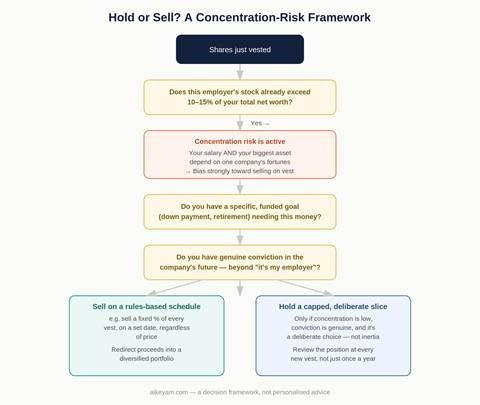
- Check your concentration first. If employer stock is already above 10–15% of your net worth, the default action on every new vest should be to sell — regardless of where the price sits that day.
- Separate “goal-funded” money from “conviction” money. If you need this money for a house down payment, your child’s education, or retirement within the next few years, it shouldn’t be sitting in a single volatile stock at all.
- Test your conviction honestly. “I work there” is not investment conviction. Would you buy this stock today, in this size, if you had no employment relationship with the company? If not, that’s a signal to trim.
- Sell on a schedule, not a feeling. The most reliable approach we see work is a rules-based one — for example, selling a fixed percentage of every vest on a fixed date, regardless of price. This removes the emotional guesswork and the temptation to “wait for a better price,” which is how most concentrated positions get more concentrated, not less.
How RSU Taxation Works in India: Two Tax Events, Not One
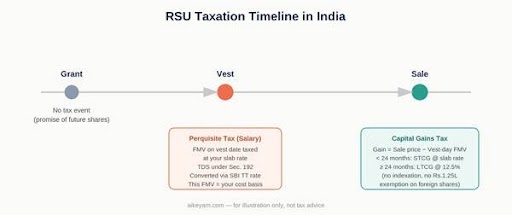
This is where most of the confusion — and most of the costly mistakes — happen. In India, RSUs are taxed twice: once when they vest, and again when you eventually sell them.
Stage 1: Perquisite Tax at Vesting
When your RSUs vest, the Fair Market Value (FMV) of the shares on the vesting date is added to your salary and taxed as a perquisite under the “Income from Salary” head — at your applicable income tax slab rate. Your employer withholds this as TDS under Section 192, the same section that governs regular salary TDS.
For foreign shares (say, US-listed stock from your global parent company), the FMV is converted to INR using the SBI Telegraphic Transfer Buying Rate (TTBR) on the vesting date, as prescribed under Rule 26 of the Income Tax Rules.
Stage 2: Capital Gains Tax at Sale
When you eventually sell the vested shares, only the appreciation since vesting is taxed — the difference between your sale price and the vest-day FMV.
Foreign shares are treated as unlisted shares for Indian capital gains purposes (even if they’re listed on a US exchange like NASDAQ or NYSE), which changes the holding-period rules compared to Indian listed equity:
| Holding Period (from vest date) | Classification | Tax Rate |
|---|---|---|
| Less than 24 months | Short-Term Capital Gains (STCG) | Your income tax slab rate |
| 24 months or more | Long-Term Capital Gains (LTCG) | Flat 12.5% (no indexation) |
Note two things employees commonly get wrong here: foreign shares do not qualify for the ₹1.25 lakh LTCG exemption available under Section 112A (that’s specific to Indian listed equity with STT paid), and the 24-month threshold is longer than the 12-month period that applies to Indian listed shares.
If You Worked Across Countries During the Vesting Period
If part of your vesting period was spent working outside India — say, you were on a US assignment before relocating back — the perquisite value may need to be apportioned between the two countries based on your workdays in each. Get this apportionment wrong, and you risk both countries taxing the same income in full, rather than just your India-linked share of it. This is a scenario worth getting a professional opinion on, since the numbers involved are rarely small.
What You Need to Report Each Year: Schedule FA and the US Tax Credit
Owning foreign employer stock doesn’t just create tax liability — it creates annual disclosure obligations, separate from the tax itself.
Schedule FA: Reporting Your Foreign Holdings
If you’re a Resident and Ordinarily Resident (ROR) taxpayer holding foreign shares — including unsold vested RSU shares — you’re required to disclose these holdings in Schedule FA (Foreign Assets) of your income tax return, using ITR-2 or ITR-3. This applies regardless of the value of the holding — there’s no minimum threshold below which disclosure is optional.
What typically needs to be reported:
- Foreign equity holdings (including unsold vested RSU shares) and their peak/closing value during the calendar year
- Any foreign bank or brokerage account linked to your RSU plan
- Dividend income received on those holdings
- Capital gains from any shares sold during the year, reported separately under Schedule CG
Missing Schedule FA disclosures isn’t a minor paperwork lapse — under the Black Money Act, penalties can run into lakhs of rupees per year of omission. If you’ve missed disclosing foreign RSU holdings in past years, it’s worth addressing proactively (through applicable disclosure or updated-return schemes) rather than waiting for a mismatch notice.
Claiming Credit for Tax Already Paid in the US
If US tax was withheld on your RSU vesting, dividends, or sale proceeds, you don’t have to absorb that as a sunk cost — the India-US Double Taxation Avoidance Agreement (DTAA) allows you to claim a Foreign Tax Credit (FTC) for tax already paid abroad on the same income.
To claim this credit:
- File Form 67 — this is mandatory and must generally be filed before you file your income tax return for the FTC to be recognised.
- Report the foreign tax paid under Schedule TR (Tax Relief) in your ITR.
- Keep documentation of the US tax withheld — W-2 statements, brokerage tax documents (like a 1099-DIV or 1099-B), or equivalent proof.
A large number of otherwise correctly filed returns get their FTC claim rejected purely because Form 67 wasn’t filed, or wasn’t filed on time — even when every other number in the return is accurate.
The Mistakes We See Most Often
Across the RSU holders we’ve worked with, the same handful of mistakes account for the vast majority of avoidable tax and wealth-planning damage:
- Never selling a single vest. Holding every share from every vest “because it might go up more” is how a 5% position quietly becomes a 40% position over a few years — usually without the employee noticing until a downturn makes it painfully obvious.
- Selling everything in one financial year. The opposite mistake — panic-selling an entire multi-year position at once — often pushes the employee into the highest tax slab for that year and can trigger a large, avoidable STCG bill on shares that were only months away from qualifying for the lower LTCG rate.
- Treating cost basis as zero. Forgetting that the vest-day FMV (already taxed as salary) is your cost basis, and instead calculating capital gains on the full sale value — resulting in tax paid twice on the same money.
- Skipping Schedule FA entirely. Many employees don’t realise unsold, vested shares sitting in a US brokerage still need annual disclosure, not just the year they’re sold.
- Missing Form 67. Paying US tax on dividends or RSU-related income and never claiming the offsetting Indian credit, effectively paying tax twice on the same income.
- Using the wrong exchange rate. Using a bank’s TT-selling rate, a different bank altogether, or an average annual rate instead of the SBI TTBR on the specific vesting date — which distorts both the perquisite value and every capital gains calculation downstream.
- No rebalancing plan at all. Treating each vest as a one-off event rather than part of an ongoing wealth-management plan, so diversification never actually happens — it just gets pushed to “next year,” indefinitely.
Building an RSU Plan That Actually Works
Managing RSUs well isn’t a once-a-year tax-filing exercise — it’s an ongoing decision loop: assess concentration at every vest, decide what to sell versus hold using a rule rather than a guess, get the tax treatment right the first time, and keep your annual disclosures clean. Get any one part wrong and it either costs you in unnecessary tax, an avoidable penalty, or a wealth plan that never actually diversifies.
Build a structured RSU strategy
At Aikeyam, we work with employees at global tech, pharma, and finance companies to build a structured RSU strategy — covering diversification planning, vest-by-vest tax computation, Schedule FA compliance, and Form 67 filing — so your equity compensation builds wealth instead of quietly becoming your biggest risk.
Written by
Kashish Manjani
Kashish blends strategic thinking with timeless financial principles — helping clients grow, protect, and align their wealth with their values. Kashish blends strategic thinking with timeless financial principles — helping clients grow, protect, and align their wealth with their values.
Featured in The Economic Times | Host of Money Talks with Kashish on YouTube.
FAQs
Frequently Asked questions
Are RSUs taxed twice in India?
Yes. RSUs are taxed once as a salary perquisite when they vest (based on fair market value), and again as capital gains when you sell them — but only on the appreciation since vesting, not the full sale value.
What tax rate applies when I sell my vested RSU shares?
Foreign RSU shares are treated as unlisted shares for capital gains purposes. If held under 24 months from vesting, gains are taxed at your income slab rate as STCG. If held 24 months or more, they qualify for LTCG at a flat 12.5% without indexation.
Do I need to report RSUs in Schedule FA even if I haven't sold them?
Yes. Any foreign equity holding — including unsold vested RSU shares — needs to be disclosed in Schedule FA if you’re a Resident and Ordinarily Resident taxpayer, regardless of value.
Can I claim credit for US tax withheld on my RSUs?
Yes, under the India-US DTAA, by filing Form 67 (generally before your ITR) and claiming relief under Schedule TR. Missing Form 67 is one of the most common reasons FTC claims get rejected.
How much of my net worth should be in employer stock?
There’s no universal number, but many wealth managers suggest capping any single stock — including employer stock — at around 10–15% of total net worth, with a clear plan to sell down anything above that threshold.
Should I sell all my RSUs the moment they vest?
Not necessarily — a rules-based approach (selling a fixed percentage on a fixed schedule) tends to work better than either holding everything indefinitely or selling everything at once, since it manages concentration without trying to time the market.