
- 5 min
Best NRI Investment Options in India (2026 Complete Guide)

Written by
Kashish Manjani
- Blog
- Financial Planning
Date
20 August 2026
YouTube
You’ve moved abroad. Built a career. Saved money in dollars, dirhams, or pounds. And now you’re asking: Should I invest this money back in India?
It’s not a simple yes or no. Because the moment you became an NRI, the rulebook changed. Different accounts. Different taxes. Different repatriation limits. Different product access.
Some investments that worked when you were a resident Indian are now off-limits. Others have become more attractive. Budget 2026 changed several rules again – equity ownership caps, property TDS compliance, and Sovereign Gold Bond taxation among them. Without clarity, you risk either missing out on growth or getting stuck in compliance trouble.
This guide gives you that clarity – covering all 15 major NRI investment routes available in India today, updated for Budget 2026.
- Safety-first NRIs: NRE and FCNR fixed deposits – tax-free interest, fully repatriable
- Growth-focused NRIs: Equity mutual funds and direct equity via the revised Portfolio Investment Scheme (individual cap now 10%, aggregate 24%, per Budget 2026)
- Currency-diversification-focused NRIs: GIFT City USD fixed deposits and India/global mutual funds – a genuinely new-for-2026 category most guides still miss
- Retirement-focused NRIs: NPS Tier-1, with a portion in NRE/FCNR deposits for stability
- HNI NRIs (Rs 1 crore+ surplus): AIFs and PMS for professionally managed, India-specific exposure
- What NRIs generally cannot do anymore: open PPF/NSC/SCSS fresh, buy new Sovereign Gold Bonds, or buy agricultural land
There’s no single best option – only the best combination for your goals, tax residency, and repatriation needs. This guide walks through all of them.
Understanding Your NRI Status Under FEMA
Before we discuss investments, you need to know one thing: every NRI investment in India falls under the Foreign Exchange Management Act (FEMA), which governs foreign exchange transactions and sets clear rules on what NRIs can and cannot do.
You’re classified as an NRI if you stay outside India for more than 183 days in a financial year. Once that happens, your financial relationship with India shifts. Your bank accounts, your tax status, your investment eligibility – all of it changes.
The good news? NRIs are allowed to invest in Indian companies, real estate, and financial instruments, with clear guidelines on repatriation.
The challenge? Understanding which account to use, which products you can access, and how taxation works – especially with Budget 2026 having reshaped several of these rules mid-year.
Not sure where you currently stand – Resident, NRI, or RNOR? Run your exact dates through Aikeyam’s RNOR Calculator before making any investment decisions; your residency status changes which of the options below even apply to you.
Know Your Three Foundation Accounts
Every NRI investment starts here. You cannot bypass this. Once you become an NRI, you cannot hold a regular savings bank account – you need specialized NRI accounts.
NRE Account (Non-Resident External)
This is where your foreign salary goes. You convert your foreign currency into rupees here.
Key features:
- Interest is tax-free in India
- Fully repatriable – both principal and interest can be moved back to your country of residence without any cap
- Used for equity mutual funds, stock investing, and NRE fixed deposits
Best for: Foreign income you want to invest in India’s equity markets
NRO Account (Non-Resident Ordinary)
This is for income you earn in India – rent from property, dividends from shares, pension payments.
Key features:
- Interest is taxable
- Repatriation capped at USD 1 million per financial year, subject to payment of applicable taxes
- TDS applies on interest
Best for: Managing domestic expenses and parking Indian income
FCNR Account (Foreign Currency Non-Resident)
Think of this as your currency hedge. You keep money in USD, GBP, EUR, or other approved currencies with an Indian bank.
Key features:
- Protects funds from exchange rate fluctuations
- Interest is tax-free in India
- Principal and interest fully repatriable
Best for: NRIs who expect rupee depreciation but want Indian bank stability
At-a-Glance: All NRI Investment Options Compared
| Investment | Risk | Liquidity | Repatriation | Typical Taxation |
|---|---|---|---|---|
| NRE Fixed Deposit | Very low | Low (locked till maturity) | Fully repatriable | Tax-free interest |
| FCNR Deposit | Very low | Low | Fully repatriable | Tax-free interest |
| NRO Fixed Deposit | Very low | Low | Capped at $1M/year | Taxed at slab + TDS |
| Equity Mutual Funds | Medium-High | High | Via NRE: fully repatriable | LTCG 12.5% above Rs 1.25L; STCG 20% |
| Debt Mutual Funds | Low-Medium | High | Via NRE: fully repatriable | Taxed at slab rate |
| Direct Equity/Stocks | High | High | Via NRE: fully repatriable | LTCG 12.5% above Rs 1.25L; STCG 20% |
| GIFT City USD FD/Funds | Low-Medium | Medium | Fully repatriable (USD) | Tax-free/treaty-dependent |
| Real Estate | Medium | Very low | Capped, documentation-heavy | LTCG 12.5% (post-Jul 2024 purchases) |
| REITs | Medium | High (exchange-traded) | Via NRE: fully repatriable | LTCG 12.5% above Rs 1.25L; STCG 20% |
| NPS Tier-1 | Medium | Very low (locked till 60) | Repatriable via NRE contributions | 60% tax-free at maturity |
| Gold ETFs/Digital Gold | Medium | High | Via NRE: fully repatriable | LTCG 12.5% (24mo+); STCG at slab |
| AIFs | High | Very low (locked 3-7 yrs) | Case-by-case | Pass-through (Cat I/II); fund-level (Cat III) |
| PMS | High | Low-Medium | Case-by-case | Capital gains basis, same as direct equity |
| Corporate Bonds/NCDs | Medium | Medium | Via NRE: fully repatriable | LTCG 20% w/ indexation (36mo+) |
| G-Secs (RBI Retail Direct) | Very low | Medium | Via NRE: fully repatriable | Slab rate; LTCG rules vary by purchase date |
Can NRI Invest in Mutual Funds? (Yes, With Rules)
For most NRIs, mutual funds are the cleanest way to participate in India’s equity markets. No stock-picking stress. No daily monitoring. Just long-term compounding.
What You Can Invest In
Equity mutual funds: Nifty 500 Index Funds give you broad exposure. S&P 500 Index Funds add global diversification.
Debt mutual funds: Invest in treasury bills, corporate bonds, government securities, and money market instruments. Since the Finance Act 2023, all debt fund gains are taxed at your slab rate regardless of holding period – a meaningful shift from the pre-2023 indexation benefit, so don’t assume debt funds are automatically tax-efficient anymore.
Hybrid funds: Work for medium-term goals like buying property in three years.
Liquid funds: Perfect for parking money before starting a Systematic Transfer Plan.
The US and Canada Problem
NRIs from the US and Canada face certain restrictions and can buy only select mutual fund schemes due to additional compliance requirements (FATCA). Not all fund houses accept US/Canada investors. Check with the AMC before you invest.
How NRI Mutual Fund Taxation Works (2024 Rules, Still Current)
For equity mutual funds:
- Short-term capital gains (held less than 12 months): Taxed at 20%
- Long-term capital gains: Tax-free up to Rs 1.25 lakh per year. Gains above Rs 1.25 lakh taxed at 12.5% without indexation benefit
For debt mutual funds:
- All gains taxed at your applicable income tax slab rate. Indexation benefit does not apply from FY 2023-24 onward.
TDS for NRIs on Mutual Funds
TDS is deducted at source on all mutual fund redemptions for NRIs:
- 12.5% for long-term equity gains, 20% for short-term equity gains
- 30% for debt fund gains
Even if your final tax liability is lower, TDS gets deducted upfront. You get the refund only after filing your Income Tax Return.
Why Mutual Funds Work for NRIs
No PIS account needed anymore for mutual funds. Online onboarding with CKYC. SIP/STP/SWP flexibility. Professional management.
If your goal is 10-20 years away, this is usually your first choice.
Can NRI Invest in Stocks in India? (Yes, With Updated 2026 Limits)
NRIs can invest through regular NRO/NRE accounts via brokers who support NRI trading, using the Portfolio Investment Scheme (PIS).
What NRIs Cannot Do
No intraday trading. No derivatives (F&O). Only delivery-based transactions are permitted.
Investment Limits (Updated – Budget 2026)
Union Budget 2026 revised the NRI equity ownership caps upward: an individual NRI can now own up to 10% of a company’s paid-up capital (up from 5% previously), and all NRIs and OCIs together can own up to 24% of any Indian company (up from 10%). If you’ve read older guides quoting 5%/10%, that information is now outdated.
Taxation
- Short-term capital gains (less than 12 months): 20%
- Long-term capital gains (over 12 months): 12.5% on gains above Rs 1.25 lakh
- TDS applies at source
Best for: Experienced investors who understand markets and FEMA compliance.
GIFT City: USD Investing for NRIs (New for 2026)
This is one of the fastest-growing – and most overlooked – routes for NRI investing, and one most “best NRI investment” guides still don’t cover well.
What Is GIFT City?
GIFT City (Gujarat International Finance Tec-City) is India’s International Financial Services Centre (IFSC) – a jurisdiction that operates under a separate regulatory framework (IFSCA) designed to let NRIs invest in dollar-denominated products without routing through NRE/NRO rupee accounts at all.
Why It Matters for NRIs
Every other option in this guide involves converting your foreign currency to rupees, taking on currency risk. GIFT City products let you invest and earn returns entirely in USD (or other foreign currencies), which solves a problem most NRI portfolios quietly carry: if you’ll eventually spend in dollars, a rupee-denominated return carries a hidden currency risk that headline return figures don’t show.
What You Can Access Through GIFT City
- GIFT City USD Fixed Deposits – tax-free interest in India, held entirely in foreign currency, with flexible short tenures
- India-focused and global mutual funds denominated in USD – exposure to Indian equity markets or global markets (US, China, etc.) without a rupee conversion step
- GIFT City AIFs – accessible to NRIs at a lower entry point than domestic AIFs in some structures
How to Invest
You typically invest through a Liberalised Remittance Scheme (LRS)-linked account or directly via GIFT City-registered fund platforms and IFSC banking units, which operate outside standard FEMA rupee-account rules. Documentation requirements are broadly similar to other NRI investments – passport, PAN, overseas address proof – but the account structure is distinct from NRE/NRO/FCNR.
Best for: NRIs who want genuine currency diversification, not just asset diversification within rupee terms. Particularly relevant if you don’t have a fixed return-to-India timeline and expect to keep spending in your country of residence.
For more detail on IFSC-regulated products, see the International Financial Services Centres Authority (IFSCA) website.
NRI Fixed Deposits: Boring, But Necessary
FDs aren’t exciting. But they’re essential for stability, short-term goals, and emergency funds.
Quick Comparison
| Account Type | Interest Taxable? | Repatriable? | Best For |
|---|---|---|---|
| NRE FD | No (tax-free) | Fully | Foreign income, higher INR returns |
| NRO FD | Yes (at slab + TDS) | Up to $1M/year | Indian income, rent parking |
| FCNR FD | No (tax-free) | Fully | Currency hedge, dollar safety |
| GIFT City USD FD | No (tax-free) | Fully, in USD | Currency diversification, short tenures |
When to use NRE FDs: When Indian interest rates are high and you want rupee exposure without market risk.
When to use FCNR or GIFT City FDs: When you expect rupee depreciation but still want either Indian bank stability (FCNR) or full currency-diversified access outside the rupee banking system entirely (GIFT City).
Real Estate for NRIs: High Emotion, Low Returns
NRIs can purchase residential and commercial properties in India but cannot buy agricultural land, plantation property, or farmhouses.
The Reality Check
Rental yields in India run 2-3%, often below inflation. Transaction costs take 6-10%. TDS applies on property sale for long-term holdings.
Capital gains tax: 12.5% without indexation if held for more than 24 months and purchased on or after 23 July 2024. Properties purchased earlier can choose between 20% with indexation or 12.5% without – whichever is lower.
Repatriation Rules
NRIs can repatriate sale proceeds of up to two residential properties, but the amount cannot exceed the original investment made in foreign currency. You’ll need Form 15CA/CB with full documentation.
Compliance Update – Budget 2026
From 1 October 2026, resident buyers purchasing property from an NRI no longer need a separate Tax Deduction and Collection Account Number (TAN) – they can deposit TDS using their existing PAN. This simplifies the buyer’s side of NRI property transactions, which historically slowed deals down. The TDS rate itself remains unchanged at 20% for long-term capital gains under Section 195.
Best for: Family use or long-term holding. Not for high returns.
REITs: Real Estate Exposure Without Buying Property
If real estate’s illiquidity above put you off, REITs solve much of that problem.
What Are REITs?
Real Estate Investment Trusts pool money from multiple investors to own income-generating commercial properties – office parks, malls, warehouses. By regulation, REITs must distribute at least 90% of their income to unit holders, creating a regular payout stream. Think of them as a mutual fund for commercial real estate.
Why They Work for NRIs
- Low entry point: Minimum investment is now around Rs 50,000 in most REIT IPOs, down sharply from earlier years
- No property management headache – no tenants, no maintenance, no local point of contact needed
- Exchange-traded liquidity – units trade on NSE/BSE, so you can exit anytime markets are open, unlike physical property
- Repatriable via NRE account, unlike direct real estate
How to Invest
Open an NRE/NRO account, set up a demat and trading account, complete KYC, and buy REIT units either at IPO or on the secondary market.
Taxation
Long-term gains (held over 12 months): 12.5% above the Rs 1.25 lakh exemption. Short-term gains: 20%. Interest-component distributions typically face 5% TDS; check the specific REIT’s distribution structure, since dividend and interest components are taxed differently.
Best for: NRIs who want real estate-linked income without real estate’s liquidity and management problems.
NPS for NRIs: Retirement Planning With Rules
NRIs with Aadhaar and PAN can open Tier-1 NPS. Tier-2 is not available to NRIs. Note: Persons of Indian Origin (PIOs) and OCIs cannot participate in NPS – this is specific to NRIs holding Indian citizenship.
Why Consider NPS
Low cost. Automatic equity-debt glide path. Up to Rs 2 lakh annual tax benefit during resident years (Rs 1.5 lakh under Section 80CCD(1) plus Rs 50,000 under 80CCD(1B)). Partial tax-free withdrawal at retirement.
The Trade-off
40% of your corpus must go into an annuity at maturity. That annuity income is taxable. Repatriation rules apply to contributions and maturity proceeds.
Best for: Goals 10-25 years away.
Gold for NRIs: ETFs, Digital Gold & the SGB Situation
Gold remains a portfolio hedge and a cultural touchstone for many NRI families – but the rules here changed meaningfully in 2026.
What You Can Actually Buy
Gold ETFs: Exchange-traded funds tracking gold prices, held via your demat account, purchased through Non-PINS accounts.
Digital gold: Purchase gold online in small denominations, stored in insured vaults by the platform on your behalf. No demat account required, making it the lowest-friction entry point.
What You Cannot Buy: Sovereign Gold Bonds (Fresh Purchases)
NRIs cannot make new investments in Sovereign Gold Bonds under current RBI/FEMA guidelines. If you bought SGBs while you were still a resident Indian, you can continue holding them to maturity.
SGB Taxation Update – Budget 2026
This is a change worth flagging even for existing SGB holders: effective 1 April 2026, the capital gains tax exemption at maturity now applies only if you subscribed directly at the original RBI issue and held to maturity. If you acquired your SGBs from the secondary market (via stock exchange trading) rather than the original issue, that exemption no longer applies – long-term gains on secondary-market SGBs are now taxed at 12.5%, short-term at your slab rate. Check how each tranche of SGBs you hold was acquired before assuming any exemption.
Taxation on Gold ETFs and Digital Gold
Held under 24 months: taxed at your income slab rate. Held longer: 12.5% long-term capital gains, without indexation. TDS generally doesn’t apply on exchange-traded ETF sales but does apply on direct redemption from the fund house.
Best for: A small hedge allocation – most planners suggest capping gold at 10-15% of a portfolio, not more.
Alternative Investment Funds (AIFs): For Larger Surpluses
What Are AIFs?
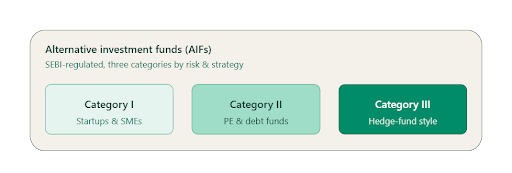
SEBI-regulated pooled investment vehicles across three categories:
- Category I – startups, SMEs, infrastructure, social ventures
- Category II – private equity, debt funds, fund-of-funds
- Category III – hedge-fund-style strategies using complex trading approaches
Entry Point
Minimum investment is Rs 1 crore for most AIFs (Rs 25 lakh for AIF employees/directors). GIFT City-domiciled AIFs sometimes offer NRI-accessible structures at different thresholds – worth exploring specifically if the Rs 1 crore domestic minimum is out of reach but you still want AIF-style exposure (see the GIFT City section above).
Taxation
Category I and II AIFs use pass-through taxation – gains are taxed at the investor level, in your hands. Category III is taxed at the fund level as business income. NRIs typically face TDS of 10-15% on long-term capital gains and around 30% on short-term gains, though this varies by AIF category and structure.
Best for: HNI NRIs with Rs 1 crore+ surplus seeking exposure to private markets, unavailable through public mutual funds or stocks.
Portfolio Management Services (PMS): Direct, Managed Ownership
What Is PMS?
Unlike mutual funds, where you own units in a pooled fund, PMS gives you direct ownership of the underlying securities in your own demat account, managed by a dedicated portfolio manager against your specific goals and risk profile.
Entry Point
SEBI mandates a minimum investment of Rs 50 lakh to open a PMS account – a meaningfully lower bar than AIFs, making this the more accessible “professionally managed, direct-ownership” option for affluent NRIs who aren’t yet at AIF minimums.
How to Invest
Open your NRE/NRO account, complete KYC, set up trading and demat accounts, and sign a discretionary or non-discretionary management agreement with the PMS provider.
Taxation
Taxed on the same capital gains basis as direct equity – the fee structure doesn’t create a separate tax category. PMS fees are typically not deductible from taxable gains when income is classified as capital gains, which is worth factoring into your net-of-fee return expectations.
Best for: NRIs wanting hands-on, direct-ownership management without meeting AIF minimums.
Corporate Bonds, NCDs & Government Securities
Corporate Bonds & NCDs
Debt instruments issued by companies to raise capital, typically offering higher yields than government securities with moderate credit risk. Not all bonds accept NRI investment – check the offer document. TDS on interest is 20%; bonds held under 36 months face 30% short-term capital gains tax, those held longer get 20% long-term capital gains with indexation.
Government Securities (G-Secs, SDLs)
Sovereign-backed debt with effectively zero default risk. The RBI Retail Direct platform lets NRIs invest directly with no investment ceiling under the Fully Accessible Route (FAR), and no brokerage fees. Register on the RBI Retail Direct portal after opening your NRE/NRO account and completing KYC.
Interest is fully taxable, with 30% TDS. Capital gains treatment depends on your purchase date: securities bought before April 2023 get 12.5% long-term tax without indexation (holding over 12 months); securities bought on or after April 2023 are taxed at slab rate regardless of holding period.
Best for: Conservative NRIs who want sovereign safety with better yields than a savings account, and don’t need FD-style simplicity.
What NRIs Cannot Invest In (2026 Rules)
Let’s clear this up:
- PPF (unless opened before NRI status)
- NSC (same rule)
- SCSS (cannot open as NRI)
- Post Office MIS
- Sovereign Gold Bonds (fresh purchases not allowed – see Gold section for the 2026 update on existing holdings)
- Agricultural land, plantation property, farmhouses
- Most small-savings schemes
Not Sure How to Put This Into One Portfolio?
Fifteen options, each with different tax rules, repatriation limits, and risk profiles – reading about them is one thing; sequencing them into a portfolio that matches your actual goals and residency status is another.
Book a free Clarity Call with Aikeyam – a SEBI Registered Investment Advisor working specifically with NRIs – and get a plan built around your numbers, not a generic allocation.
Understanding DTAA: Don't Pay Tax Twice
India has Double Taxation Avoidance Agreements (DTAA) with multiple countries, ensuring NRIs do not pay tax twice on the same income.
How it works:
- Get a Tax Residency Certificate (TRC) from your country
- Submit Form 10F in India
- Claim credit for taxes paid in India against your foreign tax liability
This applies to dividends, capital gains, and interest income across virtually every product in this guide.
Investment Strategy by NRI Profile (2026)
Gulf-Based NRIs (Tax-Free Income)
Focus on:
- NRE FDs
- Equity index funds
- GIFT City USD funds for currency diversification
- NPS Tier-1
Your tax-free foreign income gives you clean compounding – GIFT City is worth exploring here since you’re less likely to have existing dollar exposure through a home-country brokerage.
US/Canada NRIs (FATCA Restrictions)
Use:
- AMCs that explicitly allow US/Canada investments
- FCNR FDs for safety
- India equity via NRO account
- Real estate or REITs if planning to return
UK/Europe NRIs
Works well:
- Equity mutual funds
- NRE FDs (with tax planning around your home-country treaty)
- GIFT City global funds for broader international diversification beyond just India
Retiree NRIs
Build around:
- NRE FD + FCNR for stability
- Short-duration debt via NRO or G-Secs via RBI Retail Direct
- Low-volatility hybrid funds or REITs for income
- Avoid real estate and AIFs unless for personal use or already at HNI thresholds
Sample Allocation by Risk Appetite
| Profile | Safety base (FD/G-Secs) | Growth (Equity/MF) | Diversification (GIFT City/Gold) | Alternatives (AIF/PMS/RE) |
|---|---|---|---|---|
| Cautious | 60-70% | 15-20% | 10-15% | 0-5% |
| Balanced | 35-45% | 35-40% | 15-20% | 5-10% |
| Growth-focused | 15-25% | 50-60% | 15-20% | 5-15% (only if HNI) |
Four Principles for Building Your India Portfolio
1. Build Your Core Around Index Funds
Equity compounding is where long-term wealth comes from. Use Nifty 500 and S&P 500 index funds.
2. Add Stability Through Fixed Deposits – and Consider GIFT City for True Currency Diversification
Use NRE and FCNR strategically to protect against currency swings. If you want to remove rupee risk from your safety base entirely rather than just hedge it, GIFT City USD FDs are worth evaluating.
3. Avoid Hard-to-Repatriate Assets
NRO-heavy portfolios and direct real estate lock up your money. REITs solve much of the real-estate illiquidity problem if you want that asset class. Keep liquidity in mind.
4. Stay Compliant
TDS, Form 10F, TRC, Form 15CA/CB – the paperwork matters, and it’s grown more complex with each year’s Budget changes. Ignoring it creates problems later, not fewer.

Final Takeaway
India offers growth. Tax efficiency. Diversification. But only if you follow the rules – and the rules changed again this year.
Build your portfolio with clarity. Use the right accounts. Understand taxation across whichever of these 15 routes you choose. Plan repatriation carefully.
With the right structure, you can use India’s growth story without compromising liquidity, tax efficiency, or global compliance.
Working through this with an advisor rather than alone? See our guide on choosing a SEBI Registered Investment Advisor, or compare 12 SEBI-registered advisors by category before picking one.
Written by
Kashish Manjani
Kashish blends strategic thinking with timeless financial principles — helping clients grow, protect, and align their wealth with their values. Kashish blends strategic thinking with timeless financial principles — helping clients grow, protect, and align their wealth with their values.
FAQs
Frequently Asked questions
Can US NRIs invest in Indian mutual funds?
Yes, but only with select AMCs that accept US investors due to FATCA compliance requirements.
Is NRE FD interest taxable in India?
No. NRE FD interest is completely tax-free in India. The same applies to FCNR and GIFT City USD FDs.
How much can NRI repatriate from India?
From NRE/FCNR accounts: unlimited. From NRO accounts: up to USD 1 million per financial year, subject to applicable taxes and documentation.
Do NRIs need PAN card for investments?
Yes. PAN card is mandatory for nearly all NRI investments in India.
Can NRI buy Sovereign Gold Bonds?
No fresh purchases are allowed. If you bought SGBs before becoming an NRI, you can continue holding them – but note the April 2026 change: the maturity tax exemption now applies only to original RBI-issue subscribers who hold to maturity, not to SGBs bought on the secondary market.
What is the capital gains tax for NRI on mutual funds?
Equity funds: 20% short-term (under 12 months), 12.5% long-term (over Rs 1.25 lakh). Debt funds: taxed at your slab rate, with no indexation benefit since FY 2023-24.
What changed for NRI stock investing in Budget 2026?
The individual NRI ownership cap in a listed company rose from 5% to 10%, and the combined cap for all NRIs/OCIs together rose from 10% to 24%.
What is GIFT City and is it worth exploring for NRIs?
GIFT City is India’s International Financial Services Centre, offering USD-denominated investment products – fixed deposits, mutual funds, and AIFs – that avoid rupee conversion entirely. It’s particularly useful for NRIs concerned about currency risk on their India-linked returns.
Can NRIs invest in REITs and are they better than direct real estate?
Yes, NRIs can invest in REITs through their demat account. REITs solve real estate’s core problems for NRIs – illiquidity and management overhead – at a much lower entry point (~Rs 50,000 vs. crores for physical property), though they don’t offer the same personal-use option.
What's the minimum investment for AIFs and PMS as an NRI?
AIFs generally require Rs 1 crore (Rs 25 lakh for fund employees/directors). PMS requires a SEBI-mandated minimum of Rs 50 lakh – making PMS the more accessible route to professionally managed, directly-owned portfolios for affluent but not ultra-HNI NRIs.