
Step-Up SIP: How Increasing Your Monthly Investments Can Help Build Long-Term Wealth

Written by
Kashish Manjani
- Blog
- Investment
Date
27 November 2026
YouTube
Building long-term wealth is not just about investing regularly. It is also about increasing your investments as your income grows.
A Systematic Investment Plan (SIP) helps you invest a fixed amount periodically in mutual funds. However, if your salary increases every year but your SIP remains unchanged, you may not be using your growing investment capacity effectively.
This is where a Step-Up SIP can help. It allows you to increase your monthly investment by a predetermined percentage or fixed amount at regular intervals.
In this guide, understand how a Step-Up SIP works, its benefits, calculation formula and how an annual increase can potentially help you build a larger investment corpus.
What Is a Step-Up SIP?
A Step-Up SIP, also known as a Top-Up SIP, is an investment facility that allows you to increase your existing SIP contribution periodically, usually every year.
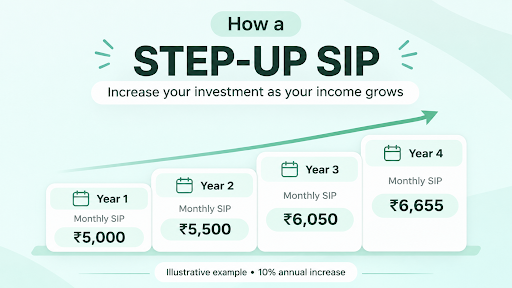
For example, suppose you start a monthly SIP of ₹5,000 and choose a 10% annual step-up.
| Year | Monthly SIP |
|---|---|
| Year 1 | ₹5,000 |
| Year 2 | ₹5,500 |
| Year 3 | ₹6,050 |
| Year 4 | ₹6,655 |
| Year 5 | ₹7,321 |
Your investment increases gradually instead of remaining fixed throughout the investment period.
This approach can help investors align their contributions with salary increments, business income growth and changing financial goals.
How Does a Step-Up SIP Work?
A Step-Up SIP works by increasing your monthly investment at a predefined interval.
There are two common methods:
Percentage-based Step-Up: Your SIP increases by a fixed percentage every year. For example, a 10% increase on ₹5,000 makes your next year’s SIP ₹5,500.
Fixed-amount Step-Up: Your SIP increases by a predetermined rupee amount every year. For example, increasing a ₹5,000 SIP by ₹500 annually results in ₹5,500 in Year 2 and ₹6,000 in Year 3.
The availability of these options and the frequency of increases depend on the mutual fund house and investment platform.
Step-Up SIP Calculation: A Practical Example
Let’s compare a regular SIP with a Step-Up SIP.
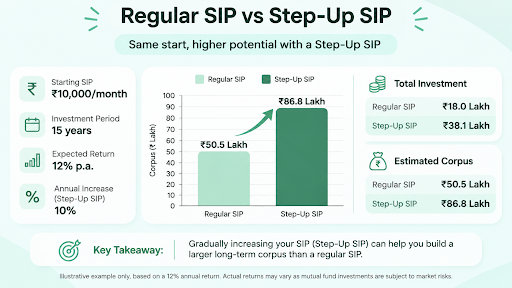
Assume an investor starts with ₹10,000 per month for 15 years.
| Particulars | Regular SIP | Step-Up SIP |
|---|---|---|
| Starting monthly SIP | ₹10,000 | ₹10,000 |
| Annual increase | 0% | 10% |
| Investment period | 15 years | 15 years |
| Assumed annual return | 12% | 12% |
| Total investment | ₹18 lakh | Approx. ₹38.1 lakh |
| Estimated corpus | Approx. ₹50.5 lakh | Approx. ₹86.8 lakh |
The Step-Up SIP has the potential to build a larger corpus because the monthly investment increases over time.
However, the higher corpus also reflects the substantially higher total amount invested.
Illustration based on monthly contributions and an assumed 12% annual return. Figures are approximate, before taxes and applicable costs. Mutual fund returns are market-linked and not guaranteed.
Step-Up SIP Formula
Unlike a regular SIP, where the investment amount remains constant, a Step-Up SIP involves changing contributions.
The monthly investment after each annual increase can be calculated as:
Pₙ = P₀ × (1 + g)ⁿ
Where:
- Pₙ = Monthly SIP in the respective year
- P₀ = Initial monthly SIP
- g = Annual step-up rate
- n = Number of annual increases
For estimating the future corpus, the future value of each monthly instalment is calculated separately and added together.
This is why a Step-Up SIP calculator is useful for projecting the overall investment value.
Step-Up SIP Calculator with Yearly Chart
A Step-Up SIP calculator helps estimate how your investment may grow when you increase your monthly contribution annually.
For example, consider a starting SIP of ₹5,000 with a 10% annual step-up.
| Year | Monthly SIP | Annual Investment |
|---|---|---|
| 1 | ₹5,000 | ₹60,000 |
| 2 | ₹5,500 | ₹66,000 |
| 3 | ₹6,050 | ₹72,600 |
| 4 | ₹6,655 | ₹79,860 |
| 5 | ₹7,321 | ₹87,846 |
| 6 | ₹8,053 | ₹96,630 |
| 7 | ₹8,858 | ₹1,06,296 |
| 8 | ₹9,744 | ₹1,16,928 |
| 9 | ₹10,718 | ₹1,28,616 |
| 10 | ₹11,790 | ₹1,41,480 |
Figures are rounded for illustration.
How to Use a Step-Up SIP Calculator
Enter the following details:
- Initial monthly SIP amount.
- Annual step-up percentage or fixed increase.
- Expected annual rate of return.
- Total investment duration.
The calculator estimates your total investment and projected maturity value.
Key Benefits of a Step-Up SIP
- Increases Investment With Income Growth
As your income increases, you can increase your SIP contribution without making a large initial financial commitment.
- Helps Build a Larger Corpus
Increasing contributions over time may help you accumulate more wealth compared with keeping your SIP unchanged, assuming similar investment returns.
- Supports Long-Term Financial Goals
Whether you are planning for retirement, children’s education or financial independence, increasing your investments can help you work towards a growing target corpus.
- Helps Address Inflation
As the cost of living increases, your financial goals may also become more expensive. Increasing your investments can help you respond to these changing requirements.
- Encourages Investment Discipline
A predefined annual increase reduces the need to manually reconsider your SIP amount every month.
Step-Up SIP vs Regular SIP: Which Is Better?
| Feature | Regular SIP | Step-Up SIP |
|---|---|---|
| Monthly contribution | Remains fixed | Increases periodically |
| Investment amount | Predictable | Changes over time |
| Income alignment | Requires manual revision | Can align with income growth |
| Long-term corpus | Depends on fixed contribution | May be higher with increased contributions |
| Suitable for | Investors with stable investment budgets | Investors expecting income growth |
Neither approach is universally better. The right choice depends on your income, financial commitments, investment horizon and ability to maintain contributions.
How Much Should You Increase Your SIP Annually?
There is no universally ideal step-up percentage.
Some investors may choose a 5% annual increase, while others may prefer 10% or a fixed rupee increase.
The decision should consider:
- Expected salary or business income growth.
- Emergency fund requirements.
- Existing loans and financial obligations.
- Upcoming financial goals.
- Investment horizon and risk tolerance.
Avoid selecting an aggressive step-up rate that makes monthly expenses difficult to manage.
Conclusion
A Step-Up SIP can be a useful strategy for investors who expect their income and investment capacity to increase over time.
By gradually increasing monthly contributions, you can put more money to work towards long-term financial goals and potentially build a larger investment corpus.
The key is to choose a sustainable annual increase, remain consistent and review your investments periodically.
Remember, the objective is not simply to invest more every year, but to build an investment strategy that remains aligned with your financial goals.
Explore Aikeyam’s Financial Advisory Services for a structured approach to long-term wealth planning.
Is Your Family's Financial Future Protected?
Organise your assets, nominations and estate plan with expert guidance from Aikeyam.
Written by
Kashish Manjani
Kashish Manjani
CFP®, CTEP · Co-founder, Aikeyam
Kashish co-founded Aikeyam, a fee-only SEBI Registered Investment Adviser. Over nine years of advising, including as AVP, Financial Advisory at a SEBI-registered adviser, she has worked with 400+ families across firms, many of them NRIs and returning Indians, on plans that span India and abroad.
Featured in The Economic Times | Host of Money Talks with Kashish on YouTube.
FAQs
Frequently Asked questions
1. What is a Step-Up SIP?
A Step-Up SIP is a mutual fund investment facility that allows investors to increase their monthly SIP contribution by a fixed amount or percentage at predefined intervals.
2. How does a Step-Up SIP work?
You begin with an initial monthly investment and select an annual increase. The SIP amount is revised according to the chosen step-up arrangement.
3. What is the ideal Step-Up SIP percentage?
There is no fixed ideal percentage. A 5% or 10% annual increase may be considered as an illustration, depending on income growth and financial commitments.
4. Is Step-Up SIP better than a regular SIP?
A Step-Up SIP may generate a larger estimated corpus because you invest more over time. However, it also requires higher contributions, so affordability matters.
5. Can I increase my existing SIP annually?
Many mutual fund houses and investment platforms offer a step-up facility for existing or new SIPs. Availability and modification rules depend on the provider.
6. Does a Step-Up SIP guarantee higher returns?
No. A Step-Up SIP increases your contributions, not the rate of return. Mutual fund investments are subject to market risks.
Kashish Manjani is a SEBI-Registered Investment Adviser (INA000019822) and the founder of Aikeyam. She holds the CFP® (Certified Financial Planner) certification from FPSB India and is a Certified Trust and Estate Planner (CTEP) — credentials that require ongoing ethics and competency standards well beyond SEBI’s baseline registration requirement.
She founded Aikeyam to make wealth management human, transparent, and impactful — built around a fee-only, goal-based, 100% fiduciary approach that keeps advice free of product conflicts.
Her perspective on financial planning and tax strategy has been featured in The Economic Times. When she’s not advising clients, she’s usually exploring a nature trail or sketching investment ideas on a napkin.
SEBI Registration No.: INA000019822