
Real Estate vs Mutual Funds: What Happened when my client wanted to quit his SIP

Written by
Kashish Manjani
- Blog
- Investment
Date
2 November 2026
YouTube
Last month, one of my clients sent me this:
“I am losing confidence in the market day by day. What if it gives less than 12% after 5 or 10 years? Instead I would like to invest in real estate to be in the safe zone.”
| About him | |
|---|---|
| Age | 42 |
| Retirement goal | Age 54, 12 years away |
| SIP started | March 2026, eight months ago |
| What he invests | Most of his salary, every month |
| What he trusts | Property and gold. “I’ve seen them grow with my own eyes.” |
The easy reply was “let’s see after one year.” I didn’t want to rely on hope. So we got on a call and I put the numbers in front of him. That included his own family’s numbers. Here is how that conversation went, worry by worry.
Worry 1: "My SIP is negative after eight months. Should I stop?"
His portfolio was down a little. So was the market, and by more:
| Change | |
|---|---|
| Nifty 50, from his first SIP (11 Mar 2026) to late October | about −5% |
| Nifty 50, from its January 2026 high | about −14% |
| His portfolio | smaller fall than the market |
His app also showed a negative XIRR that looked worse than his actual loss. XIRR annualises returns, and his average rupee had been invested for only about four months, so a small dip looked like a big one. In year one, the absolute return is the honest number.
The bigger point is that a weak first year is normal. Here is every monthly Nifty 50 SIP since July 1999:
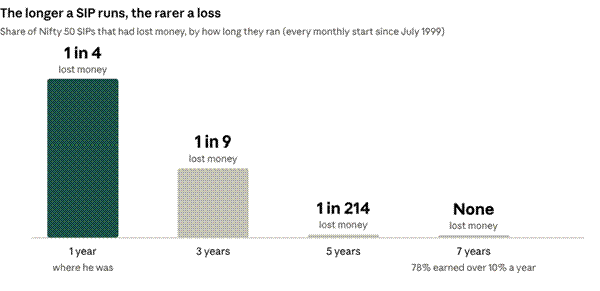
DSP Mutual Fund found something similar for every 10-year Sensex SIP over 30 years. 99% beat a debt fund by the end, but 81% were negative at some point along the way (DSP Netra, Sep 2026). Almost every SIP that ended well went through a phase like his.
What I told him: “For the first three years, we don’t talk about returns. You have 12 years. You have used eight months.”
Worry 2: "Property never falls." Is real estate really safer than mutual funds?
This was the real reason. In his words: the stock market is someone else’s business, it’s not in my control. Property I have seen with my own eyes.
Property has made many families money, and that’s real. But “it became 7x” and “it grew X% a year” are different statements. So we opened Excel on the call and calculated the yearly return on his own family’s property:
| Property deal | How it felt | Actual return per year |
|---|---|---|
| His wife’s flat, 2005 → 2026 | ₹25 lakh → ₹1.75 crore, “7x” | about 10% |
| My father’s 28 years of buying and selling property | “I’ve made a lot of money” | about 9.8% |
| Nifty 50 with dividends, 30 years | “Too risky” | 12.74% |
How to check your own property's real return
“It went up 400%” tells you nothing until you know how many years it took. Use this:
Annual return = (Current price ÷ Buying price)1 ÷ years held − 1
Here is what the big-sounding numbers usually translate to:
| It feels like… | Held for | Actual return per year |
|---|---|---|
| “It doubled” (2x) | 10 years | 7.2% |
| “5x” | 20 years | 8.4% |
| “7x” (his wife’s flat) | 20 years | 10.2% |
Individual deals vary a lot, and some do very well. But people remember the property that worked, not the one that took years to sell. One deal is one draw. The average across the whole country is the fairer comparison, and it looks like this:
| Residential property | Equity mutual funds | |
|---|---|---|
| Price growth, last 10 years | 5.2% a year | 12.7% a year |
| Cost to buy and sell | 6–8% (stamp duty, registration, brokerage) | close to nil |
| Need ₹10 lakh in a hurry? | Sell the whole flat, and wait for a buyer | Redeem in 2–3 days |
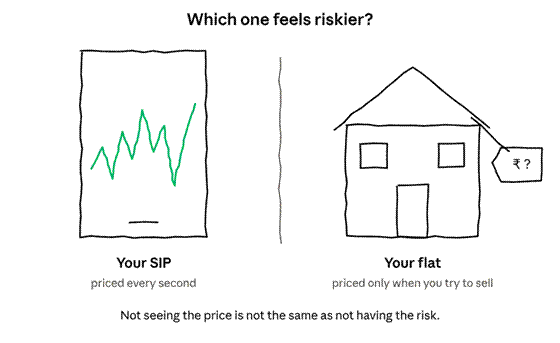
| Price shown to you | Almost never, so it feels safe | Every day, so it feels risky |
| Market right now | Sales down 6%, unsold homes up 10% (2026) | Cheapest valuations in a decade |
Sources: NHB Residex and Nifty 50 TRI via Wright Research; NSE; Anarock via KNN; Tapetide.
“Property never falls” mostly means “property is never priced in front of you.” One of my clients values his land at ₹3 crore and can’t get an offer above ₹2.7 crore. My father couldn’t sell a bungalow at ₹2.5 crore for years, and finally sold it for the same ₹2.5 crore.
You can't buy property ₹10,000 at a time
A SIP lets you start with a few thousand rupees and add more as your income grows. Property comes in one large piece. For most salaried families, the only way to buy it is a home loan, and the loan quietly changes the maths.
Illustration: a ₹1 crore flat
| Down payment (20%) | ₹20 lakh |
| Stamp duty, registration and brokerage (about 7%) | about ₹7 lakh, paid on day one |
| Home loan | ₹80 lakh at about 8.25% for 20 years |
| Monthly EMI | about ₹68,000 |
| Total interest paid over 20 years | about ₹84 lakh |
| What you’ve really paid for a ₹1 crore flat | about ₹1.9 crore |
Illustration only. Home loan rates in 2026 range from about 7.25% to over 9%, depending on the lender and borrower.
When someone says “my flat became 7x”, they almost never count the EMIs, the interest, the maintenance, the property tax or the years it sat empty. A mutual fund statement shows every cost. A property story usually doesn’t.
What I told him: “You’ve given property 20 years. All I’m asking is that you give equity three.”
None of this makes property a bad asset. His family’s property is already funding his children’s education. It just isn’t risk-free. Its risks are quieter.
Worry 3: What if mutual funds give less than 12%, or a war hits?
Fair question. So we didn’t assume 12%. We took every ₹1 lakh of monthly SIP from his age today to 54, and tested the bad cases too.
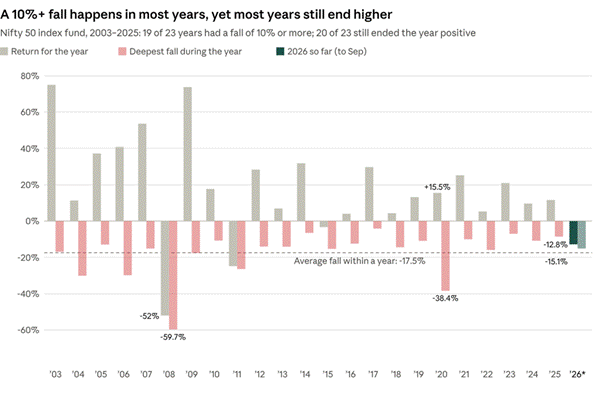
Even in a poor stretch for equity, he ends about where property normally does. That’s before property’s 6–8% entry and exit costs, and without needing a large lump sum on day one.
On war: every year the market finds a reason to scare us. Kargil, 2008, the taper tantrum, demonetisation, Covid, Russia–Ukraine, and now West Asia. His plan handles that risk in two ways:
| Risk | How the plan handles it |
|---|---|
| A crash in the next few years | Monthly investing buys more units when prices are low. 12 years is long enough to recover. |
| A crash just before retirement | From about age 50, money moves gradually into safer funds. A crash at 52 hits only a small part of the money. |
A bad year is the rule, not the exception
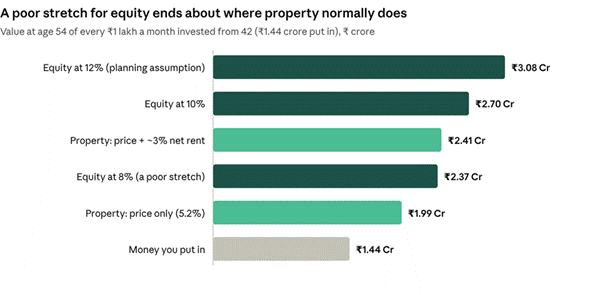
2008 fell 60%, and 2009 returned 74%. 2020 fell 38%, and the Nifty doubled from its low within a year. Volatility isn’t a flaw of equity. It’s the price of the return.
How it ended
At the end of the call he said, “I’m 50% convinced. I’ll give it three years, then take a call.”
That was honest, and it was enough. I didn’t need him to love equity. I needed him to decide with real numbers, his own family’s included, instead of a feeling formed in a bad month.
This is what an advisor is for. Fund selection is the smaller part of the job. The bigger part is:
| What clients expect from an advisor | What actually moves the outcome |
|---|---|
| Picking the best fund | Keeping you invested through the bad year |
| Predicting the market | Planning for the bad case, not just the 12% case |
| Telling you equity is better | Measuring property, gold and equity the same way |
| Higher returns | Matching each goal with money that has enough time |
On the call I said: “My job is to manage your behaviour. The market will do its job.” Eight months into a 12-year plan, that is all the job is.
Weighing property against equity for your own goals?
We’ll put both on the same yardstick, with your numbers, your timeline and your family’s real returns.
Sources: FundsIndia rolling SIP study · DSP Netra, Sep 2026 · NSE, 30 years of Nifty 50 · Wright Research, equities vs real estate · Anarock via KNN · Tapetide, Nifty PE history · Oquilia, Nifty closes · UTI Nifty 50 Index Fund calendar-year data via AMFI
Aikeyam Wealth is a SEBI Registered Investment Adviser (Registration No. INA000019822). Registration granted by SEBI, membership of BASL and certification from NISM in no way guarantee performance of the intermediary or provide any assurance of returns to investors. Investments in securities markets are subject to market risks. Read all related documents carefully before investing. Figures are historical or illustrative and do not indicate future returns. Client details have been changed to protect privacy. This article is educational and is not personalised advice.
© 2026 Aikeyam Wealth · SEBI RIA INA000019822 · money with meaning
Written by
Kashish Manjani
Kashish Manjani
CFP®, CTEP (Certified Tax and Estate Planner) · Founder, Aikeyam Wealth
Kashish runs a fee-only SEBI Registered Investment Adviser practice in Bengaluru, helping working professionals and global Indians plan with structure, not noise.
Featured in The Economic Times | Host of Money Talks with Kashish on YouTube.
FAQs
Frequently Asked questions
Should I stop my SIP if it is showing negative returns?
Usually not. About one in four Nifty 50 SIPs has been negative after one year, and none after seven years since 1999. Stopping during a fall locks in the loss and misses the low-priced units that drive the recovery. Review it against your goal’s time horizon, not one year’s return.
Is real estate better than mutual funds in India?
Over the last ten years, Indian house prices grew about 5.2% a year (NHB Residex), against about 12.7% for the Nifty 50 with dividends. Property can add rent, but it also carries 6–8% in transaction costs, low liquidity and concentration in one asset. Individual deals vary widely, so calculate the yearly return before comparing.
How long should I continue a SIP before judging it?
At least three years, and ideally to match the goal it was set up for. Equity is meant for goals five to seven years or more away.
Is 12% a realistic return to assume for equity mutual funds?
The Nifty 50 with dividends has compounded at 12.74% a year over 30 years, but returns are uneven and recent 20-year periods have been lower. A good plan is also tested at 10% and 8%, so it doesn’t depend on any one return.
Why does my SIP's XIRR look so much worse than my actual loss?
XIRR annualises returns. In the first year your money has only been invested for a few months on average, so a small dip gets annualised into a large negative number. Look at the absolute return until about year three.
How do I calculate the return on my property?
Divide today’s price by the price you paid, raise it to the power of 1 divided by the number of years held, and subtract 1. A flat that went from ₹25 lakh to ₹1.75 crore in 20 years returned about 10.2% a year, before counting loan interest, maintenance and transaction costs.