
H-1B Uncertainty: A Financial Plan That Works Whether You Stay or Return

Written by
Kashish Manjani
- Blog
- Financial Planning
Date
21 October 2026
YouTube
On October 8, 2026, the US Department of Labor suspended eight employers from the PERM labor certification programme: Microsoft, Adobe, Cognizant, Infosys, Tata Consultancy Services (TCS), Wipro, HCL and Capgemini. Officials cited alleged fraud and active federal investigations.
If you are an Indian on an H-1B, at one of these companies or elsewhere, you are probably asking the same question: do I keep waiting for a green card, or do I start planning a return to India?
Immigration lawyers can answer the visa side. This guide covers the money side, and the good news is that most of the groundwork is the same whichever way you go.
What changed, and what didn't
PERM (Program Electronic Review Management) is the labor certification step that most employer-sponsored EB-2 and EB-3 green cards must clear first. For the eight named employers, the DOL will not accept new PERM applications and has stopped processing pending ones.
What has not changed:
- Existing H-1B visas remain valid.
- Green cards already issued are unaffected.
- An approved I-140 is not revoked by the suspension, and its priority date is retained.
The suspension is not a finding of wrongdoing. Under DOL rules, an initial suspension can last up to 180 days and can be extended while an investigation continues. No end date has been announced, and details may change through written guidance or court challenges.
Speak to an immigration lawyer about your specific case. A financial plan cannot substitute for that advice.
Who is actually affected
The headline names eight companies, but the real impact is narrower and uneven.
By employer. The Indian IT services firms say they file very few PERM applications. TCS reported single-digit filings over the last two years, and Infosys reportedly filed none in 2024 or 2025. Microsoft, by contrast, is the largest PERM filer in the US. If you work at Microsoft or Adobe, this affects you most directly.
By green card stage. Where your case stands matters more than the company name.
| Your stage | What the suspension means |
|---|---|
| PERM not yet filed | Your employer cannot start PERM for now |
| PERM filed, pending | Processing has stopped |
| PERM certified, I-140 not yet filed | A certified PERM is valid for 180 days, so I-140 timing matters |
| I-140 approved | Not revoked; your priority date is retained |
| Green card issued | Unaffected |
The group under real pressure: H-1B holders near year six. H-1B status is capped at six years. Extensions beyond that generally depend on a PERM or I-140 having been filed in time. If you are approaching year six and no PERM has been filed, the suspension may turn “should I go back?” into “when do I go back?” This is the group that most needs a financial plan now.
Everyone else on an H-1B is not directly affected, but the broader crackdown is a reason to make your finances resilient to either outcome.
Four moves that work whether you stay or return
- Build more liquidity than usual. This doesn’t mean selling everything. It means knowing how much of your portfolio you could reach within a few weeks if your plans changed, and keeping that amount higher than you normally would.
- Pause hard-to-exit US commitments. A longer lease, a car loan or a home purchase can wait until your timeline is clearer.
- Hold money in both rupees and dollars. This keeps you flexible either way, and avoids converting a large sum at whatever exchange rate happens to apply the week you decide.
- Get your documents in order now. Salary slips, RSU grant and vesting records, US and Indian tax returns, 401(k) statements and immigration paperwork are far harder to collect mid-move.
If you return: plan around RNOR before you book the flight
RNOR (Resident but Not Ordinarily Resident) is a transitional Indian tax status for people coming back after many years abroad. For long-term NRIs it often lasts two to three financial years, though your exact window depends on your own travel history.
Why it matters: while you are RNOR, income that arises outside India, such as US interest, dividends or gains on US shares, is generally not taxed in India unless it is received in India or comes from a business controlled from India. You also don’t have to report foreign assets in your Indian return. It is the cleanest window you will get to reorganise US assets.
Your landing date matters. India’s tax year runs April to March, and the date you arrive within it affects whether that year counts as NRI, RNOR or resident. On the US side, your year of departure is usually a dual-status year, and afterwards the US taxes only your US-source income.
The most common mistake we see is choosing a return date around a job offer or a lease ending, without checking what it does to the RNOR window. Get your residency worked out by a tax advisor using your actual travel dates, before you move, not after.
What to do with your US assets
US accounts don’t transition cleanly when you change countries. These five need a decision before you move.
RSUs and ESPP. For many Microsoft and Adobe employees this is the largest part of their net worth, and the place where planning adds the most value.
- Concentration: a large share of wealth in one company’s stock carries risk, however well the company is doing. A move is a natural point to diversify.
- Vest timing: RSUs that vest after you leave the US can still be partly taxed in the US, based on the share of the vesting period you worked there.
- Sale timing: your tax residency in both countries on the date of sale decides how the gain is taxed. A sale planned inside the RNOR window can be far more efficient than one made before you leave or after RNOR ends.
401(k) and IRA. You have three options:
- Leave it invested. It stays tax-deferred in the US market, but you manage a US account from India, and some providers restrict access for non-US residents.
- Roll it into an IRA. A direct rollover to a traditional IRA is not taxed and can make management easier, but check the provider’s policy for Indian residents first.
- Withdraw it. Withdrawals are taxed as ordinary income, and generally carry a 10% penalty before age 59½. As a non-resident, expect 30% US withholding on distributions unless reduced under the treaty.
In India, Section 89A lets you align Indian tax on US retirement accounts with when you actually withdraw, which avoids being taxed on growth you haven’t received. Make sure your tax filings use it.
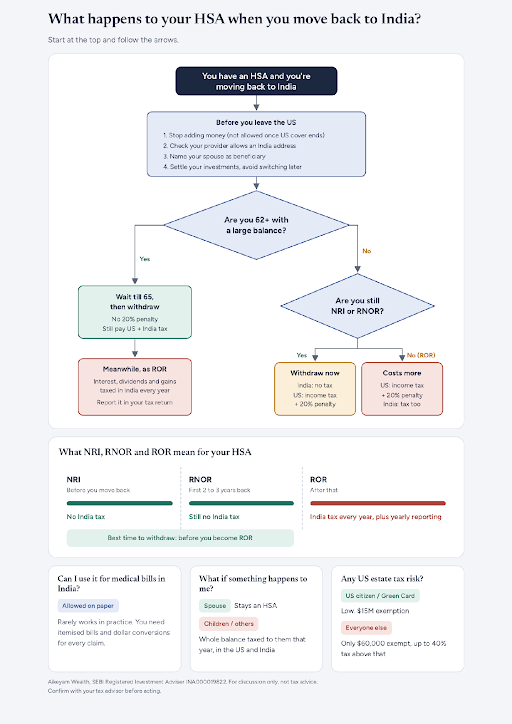
HSA. A Health Savings Account’s tax benefits exist only under US law. India does not recognise them, so once your RNOR years end its income can become taxable there. Non-medical withdrawals before 65 also carry a 20% US penalty. Decide on it as part of your overall US asset review.
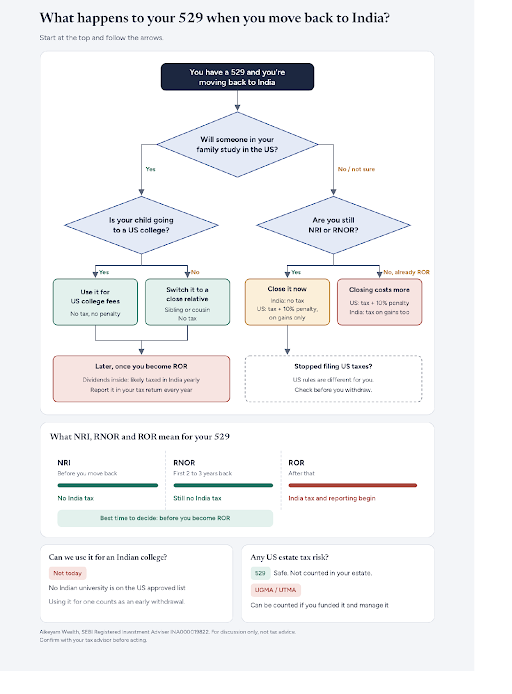
529 college savings plan. If you have children, you may also hold a 529 plan. Moving to India doesn’t force you to close it, and the right choice depends on where your family is likely to study.
- If a child will attend a US college, keep the plan. Withdrawals for qualified US tuition and fees remain tax-free and penalty-free.
- If not, you can change the beneficiary to a close family member, such as a sibling or cousin, without tax.
- If you close it, the US taxes the earnings portion and adds a 10% penalty, but only on the gains, not your contributions. Closing while you are still NRI or RNOR avoids Indian tax on those gains too.
- Indian colleges: a school must have a US federal school code for 529 money to be used there, and very few Indian institutions do. Check the Federal School Code lookup before you count on it.
For estate purposes, a 529 is generally not counted in the parent’s US estate. UGMA and UTMA custodial accounts can be, if you funded and manage them.
US brokerage and bank accounts. Some US brokers and banks restrict or close accounts once you are no longer a US resident. Ask yours directly about their policy for Indian residents well before you move, and keep at least one US account that works from India.
Setting up your Indian finances
One point confuses almost every returnee: India has two separate residency tests. Your tax status (NRI, RNOR or resident) comes from the Income Tax Act and is based on days spent in India. Your bank and investment accounts follow FEMA, under which you become resident as soon as you return to take up a job or settle, even if your tax status is still NRI or RNOR.
- NRE and NRO accounts: under FEMA these must be re-designated as resident accounts immediately on your return. This is a compliance requirement, not optional paperwork. NRE interest also stops being tax-free once the account is re-designated.
- RFC account: as a returning Indian you can open a Resident Foreign Currency account and move NRE or FCNR money into it, keeping it in dollars. It fits naturally with holding both currencies.
- FCNR(B) deposits: these can continue until maturity at the contracted rate, and the interest stays tax-free while you are RNOR. On maturity, the money moves to an RFC or a resident account.
- KYC and residency status: update your status on mutual fund folios, demat accounts and other holdings. Old NRI-status KYC affects which forms apply and how transactions are processed.
PFIC: the trap you may already be in
Under US tax law, Indian mutual funds are generally treated as Passive Foreign Investment Companies (PFICs). They come with punitive tax rules and Form 8621 reporting.
Most people think of this as a problem that starts after they move. For H-1B holders it usually works the other way round:
- While you live in the US, you are a US tax resident. Any Indian mutual funds you hold, including SIPs your family runs for you, are PFICs today.
- In your year of departure, the dual-status year, PFIC rules still apply for the part of the year you were US-resident.
- After you move, if you are no longer a US taxpayer, PFIC rules stop applying to new investments.
The exceptions are green card holders, who stay US taxpayers until they formally give up the card, and anyone who chooses to file a joint US return with a US-citizen spouse. If either applies to you, or you hold Indian mutual funds right now, review it with an advisor before adding new money.
Six mistakes to avoid
- Picking your return date for logistics alone. Check what it does to your RNOR window and your tax residency in both countries.
- Waiting until year six to plan. If your extension depends on a PERM filing that is now frozen, your options narrow quickly.
- Selling RSUs before checking residency. The same sale can cost very different amounts depending on when it happens.
- Leaving 401(k) and IRA decisions until after the move. These accounts get harder to manage once you are no longer a US resident.
- Letting NRE/NRO re-designation slip. FEMA expects it on your return, not eventually.
- Treating this as one decision. Your return date, RSU sales, retirement accounts and Indian accounts all affect each other. Plan them together.
Your H-1B to India checklist
The sections above explain what to do. This checklist tells you when to do it, so nothing important is left to the last month before your flight.
Right now, whether you stay or return
These steps cost little and keep both paths open.
- Confirm your exact green card stage (PERM, I-140, priority date) and how many years you have used on your H-1B
- Set aside a few months of expenses in cash or liquid funds you can reach quickly
- Pause new leases, car loans or a home purchase in the US
- Hold part of your savings in both US dollars and Indian rupees
- Collect salary slips, RSU grant and vesting records, US and Indian tax returns, 401(k) statements and immigration paperwork
- Check whether you or your family hold Indian mutual funds in your name, which may already be PFICs
Three to six months before you move to India
This is the planning window. Most of the tax savings for returning NRIs are decided here, not after you land.
- Work out your RNOR window with a tax advisor using your actual travel dates, and choose your landing date around it
- Map your RSU and ESPP vesting schedule, and plan any sales around your residency in both countries
- Decide what to do with your 401(k) or IRA: leave it invested, roll it over or withdraw
- Stop HSA contributions, check your provider accepts an Indian address and name your spouse as beneficiary
- If you have a 529 plan, decide whether to keep it for US college, change the beneficiary or close it
- Ask your US broker and bank about their policy for Indian residents, and keep at least one US account that works from India
When you land in India
These are compliance steps under FEMA and KYC rules. Do them in your first few weeks.
- Re-designate your NRE and NRO accounts as resident accounts
- Open an RFC account if you want to keep money in foreign currency
- Note the maturity dates of your FCNR deposits
- Update KYC and residency status on your mutual fund folios, demat account and other Indian investments
During your RNOR years
RNOR is temporary. Use it before it ends.
- Complete any planned sales of US shares or withdrawals from US accounts before RNOR ends
- Claim Section 89A treatment for US retirement accounts in your Indian tax return
- Review your portfolio as you approach ordinary resident status, when your global income becomes taxable in India and foreign asset reporting begins
In a nutshell
Whatever happens with your green card, the groundwork is the same: more liquidity, fewer hard-to-exit commitments, documents in order, and a clear view of what your US assets and Indian accounts will need. If a return is likely, the RNOR window is the most valuable planning tool you have, and it only works if you plan before you land.
Cross-border moves have a way of turning one overlooked detail in one country into an avoidable tax bill in the other. If you are weighing this decision, book a free 25-minute introductory call with Aikeyam, a SEBI-registered investment adviser working across India and the US. Write to talkto@aikeyam.com or visit https://aikeyam.com/
Written by
Kashish Manjani
Kashish blends strategic thinking with timeless financial principles — helping clients grow, protect, and align their wealth with their values. Kashish blends strategic thinking with timeless financial principles — helping clients grow, protect, and align their wealth with their values.
Featured in The Economic Times | Host of Money Talks with Kashish on YouTube.
FAQs
Frequently Asked questions
Does the PERM suspension cancel my H-1B visa?
No. Existing H-1B visas remain valid, and green cards already issued are unaffected. The suspension stops new and pending PERM applications for the eight named employers only.
Which companies are affected by the October 2026 PERM suspension?
Microsoft, Adobe, Cognizant, Infosys, Tata Consultancy Services (TCS), Wipro, HCL and Capgemini. Employees of other companies are not directly affected.
How long will the PERM suspension last?
No end date has been announced. Under DOL rules, an initial suspension can last up to 180 days and can be extended while an investigation continues.
My I-140 is already approved. Am I affected?
The suspension does not revoke an approved I-140, and you keep your priority date. Confirm the details of your case with an immigration lawyer.
What is RNOR status and how long does it last?
RNOR (Resident but Not Ordinarily Resident) is a transitional tax status for Indians returning after many years abroad. For long-term NRIs it often lasts two to three financial years. During this time, income earned outside India is generally not taxed in India unless it is received in India.
Do I have to close my 401(k) when I move back to India?
No. You can leave it invested, roll it into an IRA or withdraw it. Early withdrawals are taxed as ordinary income and usually carry a 10% penalty before age 59½, so leaving it invested is often worth considering.
Are my Indian mutual funds a problem while I'm on an H-1B?
Possibly. While you are a US tax resident, Indian mutual funds are generally treated as PFICs, with punitive US tax rules and annual Form 8621 reporting. Review any holdings with an advisor.
When do I need to convert my NRE and NRO accounts?
Under FEMA, NRE and NRO accounts should be re-designated as resident accounts as soon as you return to India to live or work, even if your income tax status is still NRI or RNOR.
Can I keep my FCNR deposit after returning to India?
Yes. An FCNR(B) deposit can continue until maturity at the contracted rate, and its interest stays tax-free while you are RNOR. On maturity, the money moves to an RFC or resident account.