
How to Choose a Financial Advisor in India: A Step-by-Step Guide

Written by
Kashish Manjani
- Blog
- Financial Planning
Date
18 September 2026
YouTube
Here’s an uncomfortable number to start with: in a 2025 survey by 1 Finance, 57% of bank relationship managers admitted to pushing products rather than giving advice suited to the client. That’s not a fringe statistic — it’s the person sitting across the desk at your neighbourhood bank branch, recommending a “great fund” that happens to carry a fat upfront commission.
So hiring a financial advisor in India isn’t really the hard part — anyone with a smartphone can find dozens of “advisors” in five minutes. The hard part is telling the difference between someone who is legally obligated to act in your interest and someone who is paid more when you buy the wrong product.
This guide walks through exactly how to vet, question, and choose a financial advisor in India — step by step — plus a dedicated section on what changes if you’re a high net worth individual (HNI) with more complex needs like PMS, AIFs, or a family office structure.
Quick Answer: To choose a financial advisor in India, first clarify why you need one, then verify they’re a SEBI-registered Investment Adviser (RIA) using the SEBI Intermediary Portal or the ARIA directory, confirm they’re fee-only (not commission-based), check their qualifications (CFP/NISM), and interview 2–3 candidates before signing on. Never hire someone who can’t produce a SEBI registration number on request.
Why This Decision Matters More Than You Think
India’s household savings pool has grown fast — gross national disposable income is up roughly 163% over the past decade — and that growth has pulled in a flood of people offering “advice”: bank RMs, insurance agents, mutual fund distributors, stockbrokers, YouTube “finfluencers,” and genuine SEBI-registered advisers, all using similar language.
The problem is that most of these roles are compensated by the product, not by the advice. A mutual fund distributor earns trail commission on what you buy. An insurance agent earns a first-year commission that can run into double digits of the premium. Neither is doing anything illegal — but neither is legally required to recommend what’s best for you, only what’s suitable.
A SEBI-Registered Investment Adviser (RIA), by contrast, operates under a fiduciary duty — a legal obligation to act in the client’s best interest, and is prohibited from earning distribution commissions on the products they advise on. That single structural difference is why “hiring a financial advisor” and “hiring an RIA” aren’t always the same decision — and why this guide leans hard on that distinction.
Types of Financial Advisors in India
Not everyone who calls themselves an “advisor” plays the same role. Here’s how the main categories differ:
| Type | Regulator | Paid By | Fiduciary Duty? | Best For |
|---|---|---|---|---|
| Registered Investment Adviser (RIA) | SEBI | Client fees only | Yes | Unbiased, holistic financial planning & investment advice |
| Certified Financial Planner (CFP) | FPSB India (certification, not a license) | Fee or commission, depends on firm | Only if also SEBI-registered | Comprehensive life-goal planning |
| Mutual Fund Distributor (MFD) | AMFI (ARN holder) | Trail commission from AMCs | No | Simple mutual fund execution, no advice fee |
| Insurance Agent / POSP | IRDAI | Commission from insurer | No | Buying insurance products (not investment advice) |
| Bank Relationship Manager (RM) | Employer bank | Salary + sales targets | No | Banking convenience — approach investment advice with caution |
| Stockbroker / Portfolio Manager | SEBI | Brokerage / PMS fee | Depends on registration | Active trading, PMS for HNIs (₹50 lakh+ minimum) |
| Robo-Advisor | SEBI (if RIA-registered) | Platform fee, often low-cost | Yes, if RIA-registered | Simple, low-cost goal-based investing |
The key takeaway: if a person’s title includes “advisor,” “planner,” or “wealth manager” but they aren’t SEBI-registered as an RIA, they are technically not legally permitted to give personalised investment advice in India — SEBI explicitly restricts the use of terms like “independent financial adviser” to registered RIAs.
Step-by-Step: How to Choose a Financial Advisor
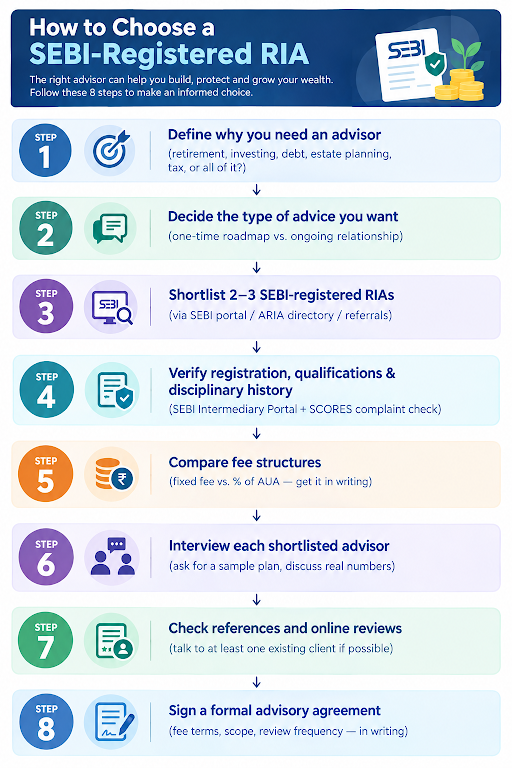
Step 1: Define why you need an advisor
Before you search “best financial advisor near me,” get specific. Are you looking for:
- Retirement and long-term wealth building
- Debt management or restructuring
- Tax planning (especially relevant for NRIs or business owners)
- Estate planning / will drafting
- One-off investment review, or a 10-20 year ongoing relationship?
Your answer shapes everything downstream — a debt-focused conversation needs a different specialist than a pure investment mandate.
Step 2: Decide the engagement type
Some RIAs offer a one-time financial plan for a flat fee (useful if you’re reasonably confident managing your own investments once guided). Others offer ongoing advisory with quarterly or annual reviews — better if your finances are complex or you’d rather not revisit this decision every year.
Step 3: Shortlist candidates
Sources worth using:
- SEBI’s Intermediary Portal — the official registry of all licensed RIAs
- ARIA (Association of Registered Investment Advisers) member directory
- Referrals from people whose financial situation resembles yours
- Professional networks (CAs, lawyers often know reputable fee-only planners)
Avoid choosing purely by Google Ads or “near me” proximity — location convenience is a poor proxy for competence, especially since most RIA engagements today happen over video calls anyway.
Step 4–8
Covered in detail in the sections below — verification, fees, the interview, references, and the agreement.
How to Verify a SEBI-Registered Investment Adviser
This is the single most important check in the entire process, and it takes under five minutes.
- Ask directly for their SEBI Registration Number — a legitimate RIA will share it without hesitation; it’s a public, disclosable credential.
- Cross-check it on the SEBI Intermediary Portal or the ARIA Members Directory to confirm the registration is active (not expired or suspended).
- Check for complaints on SEBI’s SCORES (SEBI Complaints Redress System) portal.
- Confirm qualifications — under SEBI’s January 2025 circular, individual RIAs now need a recognised finance-related degree/certification and must clear the NISM Investment Adviser exam; the earlier mandatory five-year experience requirement has been removed, so weigh qualifications and client reviews together, not experience alone.
- Watch for imposters — a common trick is someone using “SEBI registered” language loosely while actually holding only an AMFI ARN (mutual fund distributor code) or an insurance agency license, which is not the same thing at all.
Understanding Fee Structures (And the 2026 SEBI Fee Cap)
How an advisor gets paid tells you almost everything about whose interest they’re really serving.
| Fee-Only (RIA) | Commission-Based (MFD/Agent) | |
|---|---|---|
| Paid by | You, directly | Product manufacturer (AMC/insurer) |
| Conflict of interest | Minimal — regulated as fiduciary | Higher — earns more on some products |
| Typical cost | Flat fee or % of assets, capped by SEBI | “Free” advice, cost hidden in product expense ratio/commission |
| Transparency | High — fee disclosed upfront | Often opaque to the investor |
SEBI’s fee cap for RIAs
SEBI currently caps what a Registered Investment Adviser can charge a client (per family, per annum) at either a flat fee up to ₹1.25 lakh, or up to 2.5% of Assets Under Advice (AUA) — RIAs must pick one model and can’t switch between the two within a 12-month period. A separate 2025 circular also eased advance-fee collection: individual/HUF clients (who aren’t accredited investors) can now be billed up to a full year in advance, up from the earlier six-month cap, giving RIAs more flexibility on longer-term engagements.
What this means for you practically: if an advisor quotes a fee wildly above the fixed-fee cap without a clear AUA-based justification, ask them to explain exactly which model they’re using and get the fee schedule in writing before you sign anything.
Choosing a High Net Worth Financial Advisor
If your investable assets run into several crores, the calculus for choosing an advisor changes — the products available to you widen (PMS, AIFs, structured products, family offices), and so do the ways an advisor can quietly cost you money through fee layering or conflicted product placement.
| Income Type | Domestic TDS (No DTAA) | India-UAE DTAA Rate |
|---|---|---|
| Interest (NRO accounts, general) | 30%+ | 12.5% |
| Interest (bank/financial institution loans) | 30%+ | 5% |
| Dividends | 20%+ | 10% |
| Royalties | ~20% | 10% |
| Fees for Technical Services | Domestic rate applies | No separate FTS article |
What's different at the HNI/UHNI level
Build a structured RSU strategy
At Aikeyam, we work with employees at global tech, pharma, and finance companies to build a structured RSU strategy — covering diversification planning, vest-by-vest tax computation, Schedule FA compliance, and Form 67 filing — so your equity compensation builds wealth instead of quietly becoming your biggest risk.
- Portfolio Management Services (PMS): SEBI mandates a minimum investment of ₹50 lakh for PMS. A good HNI advisor will help you decide between Discretionary, Non-Discretionary, and Advisory PMS structures based on how hands-on you want to be, and will be transparent that PMS typically suits 10–20% of your total equity allocation, not the whole portfolio.
- Alternative Investment Funds (AIFs): These require a minimum commitment of ₹1 crore and pool capital across investors into strategies like private credit, pre-IPO equity, or real estate funds — higher potential return, but also higher illiquidity and risk, and worth extra scrutiny of the fund manager’s track record.
- Family offices: For UHNI families (typically those with several hundred crores or more), a Single-Family Office (dedicated to one family) or Multi-Family Office (shared infrastructure across a few families) can bundle investment management with estate planning, philanthropy structuring, and succession planning — a different scope entirely from a retail RIA engagement.
What to specifically vet for at this level
- Track record across cycles, not just the last bull run — ask for performance during at least one meaningful drawdown (2020, 2022).
- Fee layering — with PMS/AIF structures, check whether there’s a management fee plus a performance fee plus an advisory fee sitting on top, and whether that total is disclosed clearly.
- Custody and reporting transparency — for discretionary PMS in particular, you should get direct access to demat and portfolio statements, not just the manager’s periodic summary.
- Regulatory registration of every layer — the AIF/PMS manager, the advisor recommending it, and any distributor involved should each be independently verifiable with SEBI, not just the umbrella firm’s brand name.
- Succession and continuity planning for the advisory relationship itself — who handles your portfolio if your primary advisor leaves the firm?
If your needs span investment advice, tax structuring, and legacy/estate planning together, it’s worth explicitly asking a shortlisted advisor whether they coordinate with a CA and estate lawyer as a team, or whether you’ll need to stitch that coordination together yourself.
Questions to Ask Before You Hire
Bring these to every first meeting — a confident, transparent advisor will answer all of them without hedging:
- What is your SEBI registration number, and how long have you held it?
- Are you fee-only, or do you also earn commissions from any product provider?
- Can I see a sample financial plan or portfolio report you’ve prepared for another client (anonymised)?
- What’s your investment philosophy, and has it been tested through a market downturn?
- How often will we review my portfolio and plan — quarterly, annually?
- What happens if I want to exit the relationship — is there a lock-in or exit fee?
- Can you share two or three client references I can speak with?
- Who exactly will be managing my account day-to-day — you, or a junior team member?
Red Flags: When to Walk Away
- Guaranteed or unrealistic return promises — no legitimate advisor guarantees market returns.
- Reluctance or vagueness about their SEBI registration number.
- Pressure to invest immediately, especially in a “limited window” product.
- Fees that are unclear, bundled, or explained only verbally, never in writing.
- Advice that always happens to match whatever product they’re currently pushing hardest.
- No written advisory agreement — a genuine RIA engagement always comes with a signed contract outlining scope and fees.
- Choosing based purely on proximity or low cost rather than credentials — the cheapest or nearest option is rarely the same as the right fit.
Do You Even Need a Financial Advisor?
Not everyone does — at least not an ongoing one. A financial advisor is likely worth the fee if:
- Your finances have grown complex (multiple income sources, business ownership, cross-border assets, inherited wealth)
- You’re approaching a major life transition (retirement, marriage, business sale, inheritance)
- You’ve tried managing it yourself and keep procrastinating or making emotionally-driven decisions
- You want a second, unbiased opinion before committing to a large financial decision
If your situation is simpler — a salaried income, a handful of mutual funds, clear goals — a one-time consultation with a fee-only RIA to build a plan you execute yourself can be a far more cost-effective middle ground than an ongoing retainer.
Choosing Well Is a One-Time Decision That Pays for Decades
The right financial advisor isn’t the one with the flashiest office or the loudest sales pitch — it’s the one whose incentives are structurally aligned with yours, whose credentials you can independently verify, and who’s willing to put fees and scope in writing before asking for your trust.
If you’d like a second opinion on an advisor you’re already considering, or want help building a financial plan with a fee-only, SEBI-registered approach from the start, book a consultation with Aikeyam — we’re happy to walk you through exactly what a transparent engagement should look like.
Written by
Kashish Manjani
Kashish blends strategic thinking with timeless financial principles — helping clients grow, protect, and align their wealth with their values. Kashish blends strategic thinking with timeless financial principles — helping clients grow, protect, and align their wealth with their values.
Featured in The Economic Times | Host of Money Talks with Kashish on YouTube.
FAQs
Frequently Asked questions
How do I choose a financial advisor in India?
Clarify your needs, shortlist SEBI-registered Investment Advisers, verify their registration on the SEBI portal, compare fee-only vs. commission-based models, interview at least two candidates, and sign a written advisory agreement before starting.
What's the difference between a financial advisor and a mutual fund distributor?
A SEBI-registered RIA is a fiduciary paid directly by you and legally required to act in your best interest. A mutual fund distributor earns commission from the AMC on what you buy and isn’t held to the same fiduciary standard.
How much do financial advisors charge in India?
SEBI caps RIA fees at a flat rate of up to ₹1.25 lakh per family per year, or up to 2.5% of assets under advice — advisors must choose one model and can’t switch between them more than once every 12 months.
Is hiring a financial advisor worth it?
It depends on complexity. If your finances involve multiple goals, business income, inherited wealth, or cross-border elements, a fee-only advisor typically pays for itself in avoided mistakes and tax-efficient planning. Simple, single-goal situations may only need a one-time consultation.
What should a high net worth financial advisor offer that a regular advisor doesn't?
Access to and guidance on PMS (₹50 lakh minimum) and AIFs (₹1 crore minimum), coordination with tax and estate planning professionals, transparent fee-layering disclosure across multiple product structures, and often a family-office-style, multi-generational planning approach.
How do I verify if an advisor is SEBI-registered?
Ask for their SEBI registration number and cross-check it on the SEBI Intermediary Portal or the ARIA member directory; you can also check for past complaints on SEBI’s SCORES portal.