
DTAA Explained: How NRIs Avoid Double Taxation on US, UK & UAE Income

Written by
Kashish Manjani
- Blog
- Financial Planning
Date
15 September 2026
YouTube
If you’re an NRI earning rent from a flat in Bengaluru, dividends from Indian mutual funds, or interest on an NRO deposit — while also filing taxes in the US, UK, or paying zero tax in the UAE — you’ve probably wondered: does this income get taxed twice?
The honest answer is: it can, if you don’t know how to use the Double Taxation Avoidance Agreement (DTAA) correctly. Every year, thousands of NRIs quietly overpay tax on their Indian income simply because their bank deducted TDS at the default 20–30% rate instead of the lower treaty rate — and they never claimed it back.
This guide breaks down exactly what DTAA is, how it works for NRIs in the USA, UK, and UAE specifically, what’s changed under India’s new Income-tax Act, 2025, and the exact documents and steps you need to legally reduce your tax outgo.
Quick Answer: DTAA (Double Taxation Avoidance Agreement) is a tax treaty between India and another country that ensures the same income isn’t taxed twice — once in India where it’s earned, and again in your country of residence. India has DTAAs with over 90 countries, including the USA, UK, and UAE. NRIs claim DTAA benefits by submitting a Tax Residency Certificate (TRC) and the new Form 41 (which replaced Form 10F from FY 2026-27 onward) to reduce TDS and claim credit or exemption on Indian-sourced income.
What Is DTAA?
DTAA full form is Double Taxation Avoidance Agreement. It is a bilateral tax treaty signed between India and another country to decide, in advance, which country gets the right to tax a specific type of income when a person has financial ties to both.
In plain terms: DTAA income tax rules stop the Indian government and your resident country’s tax authority from both taxing the same rupee at full rates. Instead, the treaty either:
- Gives one country exclusive taxing rights, or
- Allows both countries to tax it, but requires the resident country to give credit for tax already paid in India (or vice versa), or
- Caps the tax rate at a lower, treaty-specified percentage.
So, what is DTAA in one sentence for an NRI? It’s the legal rulebook that decides how much tax you actually owe on your India-linked income — and it’s almost always less than what you’d pay without it.
Why Double Taxation Happens Without a DTAA
Double taxation occurs because two countries use different tests to claim taxing rights over the same income:
- India (source-based taxation): taxes income that arises in India — rent from an Indian property, interest on an NRO account, dividends from Indian shares, capital gains on Indian assets — regardless of where you live.
- Your country of residence (residence-based taxation): many countries (like the USA and, for citizens/green card holders, worldwide) tax their tax residents on global income, no matter where it was earned.
Example without DTAA: An NRI in London earns ₹9 lakh in rent from a Mumbai flat. India taxes it under domestic slab rates. The UK, taxing the NRI’s worldwide income as a UK tax resident, could tax the same ₹9 lakh again under its own rules. Without a treaty, that’s two tax bills for one income stream.
This is precisely the problem DTAA was designed to solve.
How DTAA Works: 3 Relief Methods
Most DTAAs, including India’s treaties with the US, UK, and UAE, use a combination of these three mechanisms:
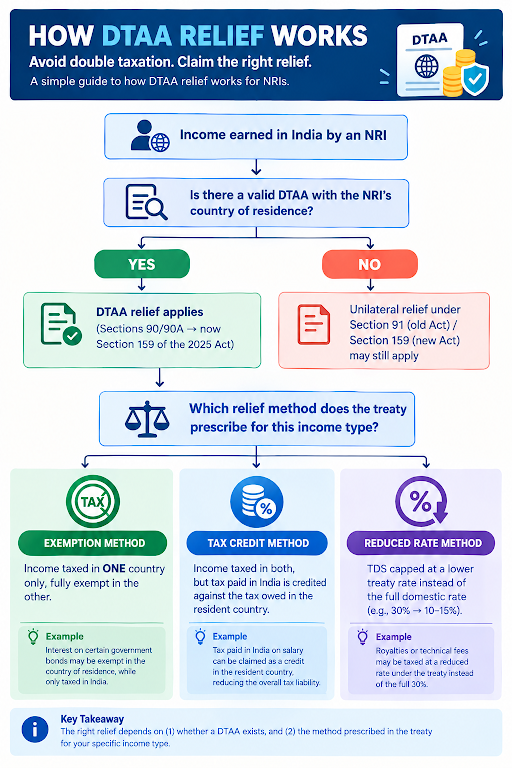
- Exemption Method — the income is taxed in only one country and fully exempted in the other. Less common for NRI-India income but applies to some specific income categories.
- Tax Credit Method — both countries can tax the income, but your resident country gives you credit (“Foreign Tax Credit” or FTC) for the tax you’ve already paid in India, so you’re not paying full tax twice. This is the primary method under the India-US DTAA.
- Reduced Rate / Deduction Method — India simply caps its TDS rate on the income (e.g., dividends taxed at a flat 20% domestically drop to 10–15% under treaty), reducing the tax bite at source itself.
This flow works well as a downloadable infographic on the page — consider commissioning a designed graphic version of this decision tree for higher on-page engagement and Pinterest/LinkedIn shareability.
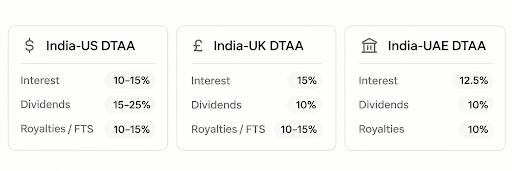
DTAA Between India and USA
The India-US DTAA (in force since 1990) is one of the most-used treaties by NRIs, thanks to the large US-based Indian diaspora — but it also comes with an extra layer most other DTAAs don’t: FATCA.
Why the US is different
The United States taxes its citizens and Green Card holders on worldwide income, regardless of where they live. So even an NRI who has lived in India for 10 years but holds a Green Card may still need to file a US Form 1040 declaring Indian income. The India-US DTAA works primarily through the tax credit method — tax paid in India can be claimed as a Foreign Tax Credit (FTC) against US tax liability (via IRS Form 1116), preventing full double taxation.
DTAA Between India and UK
The India-UK DTAA allows UK-resident NRIs to claim relief on Indian-sourced dividends, interest, pensions, and investment income. The UK also allows remittance-based taxation for certain non-domiciled residents, meaning some foreign income is taxed only when actually brought into the UK — but this depends on individual domicile status and should be verified with a UK tax advisor.
| Income Type | Domestic TDS (No DTAA) | India-UK DTAA Rate |
|---|---|---|
| Interest | 30%+ | 15% |
| Dividends | 20%+ | 10% |
| Royalties / Fees for Technical Services | 20% / 10% | 10–15% |
| Pension income | Slab rate | Often preferential/exempt (treaty-specific) |
UK-based NRIs typically use the tax credit method for relief in the UK on Indian-sourced income already taxed in India.
DTAA Between India and UAE
The India-UAE DTAA works a little differently, because the UAE does not levy personal income tax at all. That means there’s usually no “double” tax to relieve on the UAE side — but the treaty still matters, because it caps how much India can tax UAE-resident NRIs at source.
Common misconception: The India-UAE DTAA does not make your Indian income tax-free. It only limits India’s TDS rate and confirms India’s residual right to tax India-sourced income. Your UAE salary and UAE business income remain untouched by Indian tax — but rent, dividends, interest, and capital gains from Indian assets are still taxable in India, just at reduced rates.
| Income Type | Domestic TDS (No DTAA) | India-UAE DTAA Rate |
|---|---|---|
| Interest (NRO accounts, general) | 30%+ | 12.5% |
| Interest (bank/financial institution loans) | 30%+ | 5% |
| Dividends | 20%+ | 10% |
| Royalties | ~20% | 10% |
| Fees for Technical Services | Domestic rate applies | No separate FTS article |
Build a structured RSU strategy
At Aikeyam, we work with employees at global tech, pharma, and finance companies to build a structured RSU strategy — covering diversification planning, vest-by-vest tax computation, Schedule FA compliance, and Form 67 filing — so your equity compensation builds wealth instead of quietly becoming your biggest risk.
DTAA Between India and UAE
India currently has DTAAs with over 90 countries (some sources cite 94+ following recent treaty updates). Here’s a snapshot by region — this is illustrative, not exhaustive:
| Region | Countries |
|---|---|
| North America | USA, Canada |
| Europe | UK, Germany, France, Netherlands, Switzerland, Portugal, Spain |
| Middle East | UAE, Saudi Arabia, Qatar, Oman, Kuwait |
| Asia-Pacific | Singapore, Australia, Japan, South Korea, Hong Kong, Malaysia |
| Others | Mauritius, South Africa, Brazil |
Always check the Income Tax Department’s official DTAA list for the current, authoritative country list and treaty text, since rates and country coverage are periodically updated.
Benefits of DTAA for NRIs {#benefits-of-dtaa}
Benefits of DTAA for NRIs go well beyond “you don’t pay tax twice.” Here’s the fuller picture:
- Lower TDS at source — instead of the default 20–30% deduction, treaty rates often bring this down to 10–15%, improving your cash flow immediately instead of waiting for a refund.
- Foreign Tax Credit eligibility — tax paid in India can offset your liability in your resident country (subject to that country’s FTC rules).
- Clarity on which country taxes what — removes ambiguity on salary, pension, capital gains, and business income taxation.
- Reduced compliance friction on repatriation — cleaner tax positions make it easier to get CA certification (Form 15CA/15CB) for remitting funds abroad.
- Avoids double compliance burden on the same rupee — you’re not fighting two tax departments over one income stream.
- Protects specific income categories — e.g., certain pension income, pensions for government service, or short-stay employment income may be fully protected under specific treaty articles.
Documents Required: TRC & Form 41 (2026 Update)
This is where most NRIs lose money — not because DTAA doesn’t apply to them, but because they never submitted the right paperwork, so their Indian bank or payer had no choice but to deduct tax at the full domestic rate.
1. Tax Residency Certificate (TRC)
A certificate issued by the tax authority of your country of residence (IRS in the US, HMRC in the UK, the UAE Ministry of Finance for UAE residents) confirming you are a tax resident there for the relevant year. This is the foundational document — without it, no DTAA claim is valid.
2. Form 41 — the new Form 10F (important 2026 update)
Here’s something many older blog posts on this topic haven’t caught up on yet: Form 10F has been replaced.
Under India’s new Income-tax Act, 2025 (effective for income from FY 2026-27 onward), the self-declaration NRIs used to file as Form 10F under old Section 90(5)/90A(5) and Rule 21AB is now Form 41, governed by Section 159(8) and Rule 75 of the Income-tax Rules, 2026.
| Old Regime (up to FY 2025-26) | New Regime (from FY 2026-27) | |
|---|---|---|
| Form name | Form 10F | Form 41 |
| Governing section | Sections 90(5) / 90A(5) | Section 159(8) |
| Governing rule | Rule 21AB | Rule 75 |
| Filing mode | Online, e-filing portal | Online only, e-filing portal |
| PAN required? | Recommended, workaround existed | Not mandatory — non-PAN holders can register with a Non-Resident ID |
Key practical points about Form 41:
- It must be filed electronically on the Income Tax e-filing portal, once per tax year, whenever DTAA benefit is claimed.
- It should ideally be filed before your Indian payer (bank, tenant, mutual fund, employer) calculates and deducts TDS — not after.
- Once submitted, it cannot be edited, so double-check your TRC details, TIN, and residential information before filing.
- Without a validly filed Form 41 and an uploaded TRC, DTAA benefit will simply be denied — your payer will deduct TDS at the full domestic rate, and you’ll need to claim the excess back by filing an Indian ITR (a slower, cash-flow-negative route).
3. Other supporting documents
- Valid passport and visa/residency proof
- PAN (if held) or Non-Resident registration ID
- Tax Identification Number (TIN) of your resident country
- Self-declaration of beneficial ownership of income (for certain payments)
Step-by-Step: How to Claim DTAA Benefits
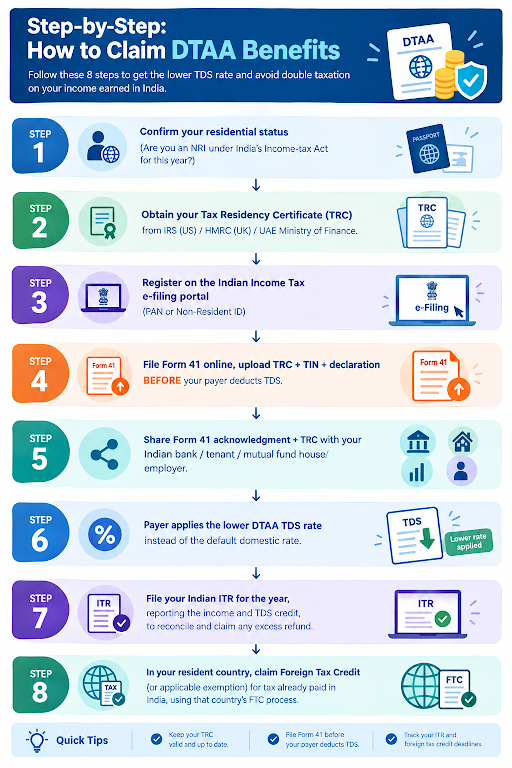
If you missed filing Form 41 in time and TDS was deducted at the full rate, you haven’t lost the benefit permanently — you can still claim the excess back by filing your Indian Income Tax Return and reporting the correct DTAA rate applicable to that income.
DTAA for NRIs: Real Examples
DTAA for NRIs example — dividend income, USA: An NRI in the US earns ₹20 lakh gross dividend from Indian shares. Without DTAA, this could attract TDS up to 20%+ (plus surcharge/cess) in India. Under the India-US DTAA, the rate caps at 25% for portfolio dividends (or 15% with qualifying shareholding) — and crucially, the US allows a Foreign Tax Credit for the Indian tax paid, via Form 1116, so the same dividend isn’t taxed again in full in the US.
DTAA for NRIs example — rental income, UK: An NRI in London earns ₹9 lakh annual rent from a flat in Pune. India taxes this as rental income under domestic slabs after standard deductions. The UK, taxing the NRI’s global income, would allow credit for Indian tax paid on this same rent under the India-UK DTAA — so the NRI’s UK liability is reduced by the tax already paid in India, rather than facing the full UK rate on top.
DTAA for NRIs example — NRO FD interest, UAE: An NRI in Dubai holds an NRO fixed deposit earning ₹4 lakh interest annually. Domestic TDS would be 30%+ surcharge and cess. With a valid TRC and Form 41 filed under the India-UAE DTAA, the rate drops to 12.5% — a direct, immediate cash-flow saving, since the UAE itself levies no personal income tax to “credit” against.
Common Mistakes NRIs Make
- Not filing Form 41 (or the old Form 10F) at all, assuming the bank will “automatically” apply DTAA — it won’t.
- Filing it after TDS has already been deducted, missing the window for lower withholding and having to chase a refund instead.
- Confusing “DTAA applies” with “zero tax” — especially common among UAE-based NRIs, who sometimes assume Indian income becomes tax-free. It doesn’t; it’s taxed at a reduced treaty rate.
- Letting the TRC expire — TRCs are typically valid for one financial year and must be renewed annually.
- Not reconciling TDS credit in the Indian ITR, leaving refundable excess tax unclaimed for years.
- Ignoring FATCA/FBAR obligations (US NRIs) — DTAA doesn’t remove your US filing obligations; it only prevents double taxation on the amount you owe.
DTAA vs Residential Status vs FEMA — Don't Confuse These
A frequent source of confusion: your residential status under the Income-tax Act (Resident/NRI/RNOR), your residential status under FEMA (which governs which bank accounts — NRE/NRO/FCNR — you can hold), and your DTAA eligibility are three separate determinations, even though they often move together.
- Income-tax residential status decides whether your global income or only your India-sourced income is taxable in India.
- FEMA residential status decides your banking and investment rules — which accounts you can operate, repatriation limits, etc.
- DTAA eligibility only kicks in once you’ve established tax residency elsewhere — it’s the treaty layer that then decides the rate and method of relief on the India-sourced income that remains taxable.
Getting these three mixed up is one of the most common reasons NRI tax notices happen — worth a professional review if you’re unsure which category you fall into this financial year.
Getting DTAA Right Isn't a DIY Guessing Game
DTAA can genuinely save you lakhs in TDS every year — but the rules differ by country, by income type, and now, by which Income-tax Act applies to your filing year. A single missed form or an expired TRC is often the difference between a smooth low-TDS deduction and months of chasing a refund.
If you’re an NRI in the US, UK, or UAE and want a second set of expert eyes on your DTAA position — from checking your residential status to filing Form 41 correctly and reconciling your ITR — talk to Aikeyam’s NRI tax specialists for a personalised review before your next TDS cycle or filing deadline.
Written by
Kashish Manjani
Kashish blends strategic thinking with timeless financial principles — helping clients grow, protect, and align their wealth with their values. Kashish blends strategic thinking with timeless financial principles — helping clients grow, protect, and align their wealth with their values.
Featured in The Economic Times | Host of Money Talks with Kashish on YouTube.
FAQs
Frequently Asked questions
What is DTAA?
DTAA (Double Taxation Avoidance Agreement) is a tax treaty between two countries — like India and the USA, UK, or UAE — that prevents the same income from being taxed in full in both countries.
What is the DTAA full form?
DTAA stands for Double Taxation Avoidance Agreement.
How many countries does India have a DTAA with?
India has DTAAs with 90+ countries, including the USA, UK, UAE, Canada, Singapore, Australia, and Germany.
What documents do I need to claim DTAA benefits?
A valid Tax Residency Certificate (TRC) from your country of residence and Form 41 (which replaced Form 10F under the Income-tax Act, 2025), filed electronically on India’s Income Tax e-filing portal.
Does DTAA mean I pay zero tax in India?
No. DTAA reduces the tax rate or shifts taxing rights — it doesn’t eliminate Indian tax on India-sourced income, especially for UAE-based NRIs who sometimes assume this incorrectly.
Is DTAA the same for all NRIs regardless of country?
No. Each DTAA is a separate bilateral treaty with its own rates and rules — the India-US, India-UK, and India-UAE DTAAs each have different rates for interest, dividends, and royalties.
What happened to Form 10F?
Form 10F has been replaced by Form 41 under Section 159(8) and Rule 75 of the Income-tax Act, 2025 and Income-tax Rules, 2026, applicable from FY 2026-27 onward.
Can I claim DTAA benefit after TDS has already been deducted at the higher rate?
Yes — you can claim the excess TDS back as a refund by filing your Indian Income Tax Return (ITR) for that year and reporting the correct treaty rate.