
UCITS ETFs vs US ETFs for Indian Investors: Taxation, Costs and Estate Planning

Written by
Kashish Manjani
- Blog
- Financial Planning
Date
13 October 2026
YouTube
Two ETFs can track the same S&P 500 and own the same Apple, Microsoft and Nvidia shares. Yet one can leave you with a different tax bill, a different cost drag and, in the worst case, a very different outcome for your family. The reason is the legal wrapper around the fund, not the stocks inside it.
This guide to UCITS ETFs vs US ETFs explains how the two structures differ for Indian residents across taxation, costs and estate planning. We have kept it practical, because the right choice depends on your portfolio size, holding period and family situation, not on a single “better” label.
Key Takeaways
- Neither structure is universally better. Access, costs, tax and estate exposure decide the fit.
- An Ireland-domiciled UCITS ETF typically suffers 15% US dividend withholding inside the fund. A US-domiciled ETF typically faces 25% withholding when it pays you.
- Accumulating UCITS ETFs defer Indian tax on income until you sell. They do not remove it.
- US-domiciled ETF units are generally treated as US-situs assets for US estate tax. Irish or Luxembourg UCITS units generally are not.
- Compare after-tax, after-cost outcomes, not just expense ratios.
UCITS ETFs vs US ETFs: What Are You Really Comparing?
UCITS (Undertakings for Collective Investment in Transferable Securities) is a European regulatory framework. It is not an exchange, a currency or an index. A UCITS ETF is usually domiciled in Ireland or Luxembourg, may be listed in London, and may hold only US companies.
A US ETF here means a US-domiciled fund regulated under US securities law and listed on exchanges such as NYSE Arca or Nasdaq.
Three labels get mixed up constantly, so separate them before you compare anything:
- Domicile (where the fund is legally set up) drives tax and estate treatment.
- Listing venue and currency (for example, LSE in USD) drive trading cost and access.
- Underlying holdings drive market risk and return.
UCITS ETFs vs US ETFs
| Factor | UCITS ETF (Ireland/Luxembourg) | US-domiciled ETF |
|---|---|---|
| Typical expense ratio | Competitive, often slightly higher than the cheapest US core funds | Some core index funds are extremely cheap |
| Income options | Accumulating and distributing classes common | Mostly distributing |
| US dividend withholding | Around 15% at fund level (treaty-qualified Irish funds) | Around 25% on distributions to an eligible Indian resident |
| Foreign tax credit in India | Fund-level tax generally not claimable by you | Investor-level withholding may be claimable via Form 67 |
| US estate tax exposure | Generally outside US-situs stock | Generally US-situs property |
| Product range | Broad, but narrower than the US market | Widest range, including niche and leveraged products |
| Trading hours (IST) | European session | US session, late evening in India |
| Fractional investing | Depends on your platform | Widely available for major ETFs |
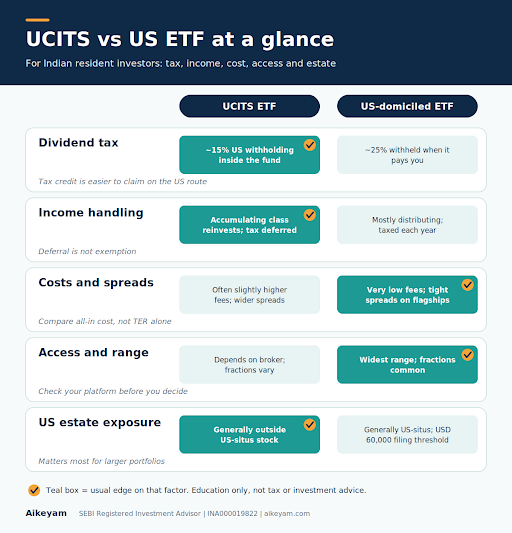
Taxation: The Three Layers Indian Investors Must Understand
The popular claim, “UCITS pays 15%, US ETFs pay 25%”, is incomplete. The two taxes hit at different points, and Indian tax comes on top.
| Layer | Accumulating Irish UCITS ETF | US-domiciled distributing ETF |
|---|---|---|
| 1. US company to fund | ~15% withheld inside the fund | Not applied at this stage |
| 2. Fund to you | No cash distribution; income reinvested | ~25% US withholding on the payout |
| 3. Indian tax return | No dividend receipt; gains taxed when you sell | Gross dividend taxed at your slab; US tax may be claimed as credit |
A Worked Example
Assume the underlying shares pay USD 200 in dividends, you are in the 30% slab, and we ignore cess, surcharge and fees.
Accumulating UCITS ETF: USD 30 is withheld inside the fund, USD 170 is reinvested automatically, and you owe no Indian dividend tax this year.
US-domiciled ETF: USD 50 is withheld, you receive USD 150, and India taxes the gross USD 200 at 30%, which is USD 60. If the full USD 50 qualifies as a foreign tax credit, you pay USD 10 more in India. Your net retained income is USD 140.
So the UCITS route kept USD 30 more in this simplified year. But that gap is partly deferral: Indian capital gains tax will apply when you sell the UCITS units. Also, the US-domiciled fund’s lower fee and your foreign tax credit narrow the gap. Model your own numbers before concluding anything.
Capital Gains in India
For an Indian resident, both structures are foreign-listed assets. Under the current framework, gains become long-term after 24 months and are generally taxed at 12.5% without indexation, with short-term gains at your slab rate. The concessional treatment available to Indian listed equity bought with STT generally does not apply. Rules change often, so confirm the latest position on the Income Tax Department portal or with your adviser.
Resident investors must also report foreign assets in Schedule FA of the return. Our guide on FAST-DS 2026 and foreign asset disclosure explains what the tax department is now looking for.
Costs: Look Beyond the Expense Ratio
A 0.04% fee gap sounds decisive. On ₹10 lakh it is about ₹400 a year. Meanwhile, a one-time 0.20% loss from poor execution or forex markup costs ₹2,000 on day one, the equivalent of five years of that fee gap.
Use a full cost equation:
All-in cost = remittance and forex markup + brokerage + bid-ask spread + expense ratio + tracking difference + unrecoverable tax drag
Practical checks before you buy:
- Spread: Flagship US ETFs often trade at very tight spreads. UCITS ETFs can be wider, especially outside European trading hours, so use limit orders.
- Fractions: If one UCITS unit costs several hundred dollars and your platform does not offer fractions, small monthly investments may sit idle as cash.
- Remittance: Both routes typically use the RBI’s Liberalised Remittance Scheme (USD 250,000 per financial year). Check TCS and forex charges, which are common to both and not a wrapper advantage.
Issuer factsheets, such as those on iShares, show current expense ratios and tracking difference. Always compare the exact share class.
Estate Planning: The Factor That Can Outweigh Everything Else
For larger portfolios, this section matters most. The IRS treats stock of US-organised corporations as US-situs property for nonresident non-citizens, wherever your brokerage account sits. Units of a typical US-domiciled ETF fall into that category. Units of an Irish or Luxembourg UCITS fund are generally analysed differently, even when the fund owns US shares.
US estate tax can apply when US-situs assets exceed USD 60,000 at death, and the executor generally has to file Form 706-NA. The IRS explains the rules on its page for nonresidents with US assets. The USD 60,000 figure is a filing threshold, not a tax-free limit. Rates run progressively up to 40%, and India does not currently have an estate tax treaty with the US.
| US-situs ETF value at death | Tentative tax | Less USD 13,000 credit | Illustrative tax due |
|---|---|---|---|
| USD 50,000 | Below filing threshold | – | USD 0 |
| USD 100,000 | USD 23,800 | USD 13,000 | USD 10,800 |
| USD 300,000 | USD 87,800 | USD 13,000 | USD 74,800 |
At an assumed ₹90 per USD, the last row is a ₹2.7 crore holding with roughly ₹67 lakh of illustrative tax. These figures assume no deductions, prior gifts or treaty relief, and actual results depend on your circumstances at the time.
A UCITS ETF can reduce this specific exposure. It does not replace a Will, nominations or an Indian succession plan. If you hold US shares directly, add them to the total as well. Our guide to estate, gift and exit taxes for US NRIs covers the wider picture, and our Will & Estate Planning service helps families put a structure in place.
Which Structure Fits You? A Simple Decision Flow
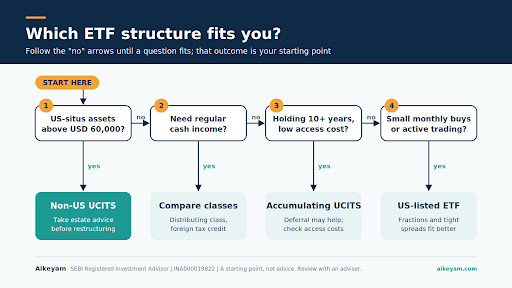
Read left to right: follow the “no” arrows until a question fits you, then take that outcome as your starting point.
- Is your total US-situs exposure (ETFs plus US shares) above, or heading above, USD 60,000? Yes → lean towards non-US-domiciled UCITS and take estate advice. No → go to step 2.
- Do you need regular cash income from the ETF? Yes → compare distributing classes and foreign tax credit carefully. No → go to step 3.
- Is your holding period 10 years or longer, with controlled access costs? Yes → an accumulating UCITS ETF may fit. No → go to step 4.
- Do you invest small amounts monthly, or trade actively? Yes → a US-listed ETF with fractions and tight spreads may be more practical.
Treat the outcome as a starting point, not a verdict.
Common Mistakes Indian Investors Make
- Assuming “accumulating” means tax-free. It means no cash payout, not no tax.
- Judging funds by the ticker or trading currency instead of the legal domicile and ISIN.
- Comparing expense ratios while ignoring spreads, forex markup and tax drag.
- Forgetting Schedule FA reporting and Form 67 for credit claims.
- Ignoring estate exposure until the portfolio is already large.
How Aikeyam Can Help
We are a SEBI-registered, fee-only adviser. We earn no commissions from fund houses, so our view of UCITS ETFs vs US ETFs is built around your goals, not a product. We look at your tax slab, holding period, remittance costs, reporting duties and estate position together, then design a plan you can follow with confidence.
- Planning global exposure? See our Investment Planning & Management service.
- Worried about capital gains and credits? Explore Tax & Capital Gains Planning.
- Based abroad? Visit our NRI Investments page.
Written by
Kashish Manjani
Kashish blends strategic thinking with timeless financial principles — helping clients grow, protect, and align their wealth with their values. Kashish blends strategic thinking with timeless financial principles — helping clients grow, protect, and align their wealth with their values.
Featured in The Economic Times | Host of Money Talks with Kashish on YouTube.
FAQs
Frequently Asked questions
Are UCITS ETFs better than US ETFs for Indians?
Not always. UCITS ETFs can help with accumulation, lower fund-level US withholding and estate exposure. US ETFs often win on fees, spreads and access. Your situation decides.
Do I pay tax on an accumulating UCITS ETF in India every year?
Generally there is no dividend receipt, so tax is usually deferred until you sell. You still need to report the holding in Schedule FA.
Can I claim foreign tax credit on a UCITS ETF?
Tax withheld inside the fund is generally not your own creditable tax. Credit is more straightforward for US withholding applied to your own distributions, subject to Form 67 and documents.
Does a UCITS ETF fully remove US estate tax risk?
It can reduce exposure to US-situs assets, but it does not remove Indian succession needs or cover US shares you hold directly.