
ESOP Taxation in India: Complete Guide for AY 2027-28

Written by
Kashish Manjani
- Blog
- Investment
Date
13 November 2026
YouTube
Employee Stock Option Plans (ESOPs) allow employees to own a stake in the company they work for. They are particularly popular among startups and multinational companies as a way to reward employees, retain talent and encourage long-term participation in business growth.
However, receiving stock options also comes with tax responsibilities. Employees often have questions about when ESOPs become taxable, how much tax they must pay when exercising options and what happens when they eventually sell their shares.
Understanding ESOP taxation in India is important to avoid unexpected tax liabilities and plan your finances effectively.
This guide explains ESOP taxation for Tax Year 2026-27 (commonly searched as AY 2027-28), including practical calculations, capital gains and special tax benefits for eligible startup employees.
What Is an ESOP (Employee Stock Option Plan)?
An Employee Stock Option Plan (ESOP) is a company benefit that gives employees the right to purchase company shares at a predetermined price, known as the exercise price, after fulfilling specified conditions.
Companies generally offer ESOPs to:
- Retain talented employees.
- Reward employee performance.
- Encourage long-term commitment.
- Provide ownership participation in business growth.
For example, a startup grants an employee 1,000 stock options at an exercise price of ₹100 per share. After completing the vesting conditions, the employee can exercise the options and purchase shares at ₹100 each, even if their market value has increased.
How Does an ESOP Work?
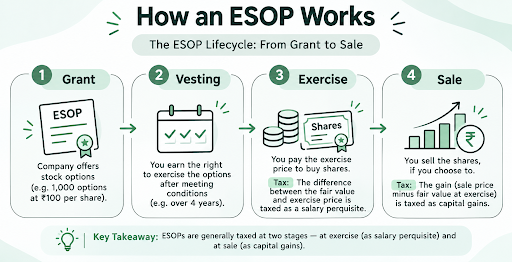
The ESOP process generally involves four stages:
- Grant: The company offers stock options to the employee.
- Vesting: The employee earns the right to exercise options after meeting specified conditions.
- Exercise: The employee pays the exercise price to acquire shares.
- Sale: The employee sells the acquired shares, potentially earning a capital gain.
How Are ESOPs Taxed in India?
ESOP taxation in India generally involves two separate taxable events:
| Stage | Tax treatment |
|---|---|
| Grant | Generally no immediate tax |
| Vesting | Generally no immediate tax |
| Exercise and allotment | Taxable as salary perquisite |
| Sale of shares | Taxable as capital gains |
Under Section 17(1)(d) of the Income-tax Act, 2025, the value of specified securities allotted or transferred by an employer free of cost or at a concessional rate is generally taxable as a salary prequisite.
Stage 1: Taxation at the Time of Exercise
When an employee exercises ESOPs and receives shares, the difference between the Fair Market Value (FMV) and the exercise price is generally treated as salary perquisite.
Formula:
Taxable Perquisite = (FMV − Exercise Price) × Number of Shares
This amount is added to the employee’s salary income and taxed at applicable income-tax rates.
Example of ESOP Taxation at Exercise
Suppose an employee exercises 1,000 options.
| Particulars | Amount |
|---|---|
| Number of shares | 1,000 |
| Exercise price per share | ₹100 |
| Fair Market Value per share | ₹500 |
| Difference per share | ₹400 |
| Total taxable perquisite | ₹4,00,000 |
The ₹4 lakh difference is generally added to the employee’s taxable salary.
If the employee falls within a 30% marginal tax bracket, the additional basic income tax could be approximately ₹1.20 lakh, before applicable cess, surcharge and other adjustments.
How Is Fair Market Value Determined?
The valuation depends on whether the shares are listed or unlisted.
- Listed shares: Generally, the average of the opening and closing prices on the relevant recognised stock exchange on the exercise date, subject to prescribed conditions.
- Unlisted shares: Fair Market Value determined by a merchant banker under the prescribed valuation rules.
For Tax Year 2026-27, refer to Rule 15 of the Income-tax Rules, 2026.
Capital Gains Tax When You Sell ESOP Shares
The second taxable event occurs when the employee sells the shares acquired through exercising ESOPs.
The difference between the sale price and the recognised cost of acquisition is generally treated as capital gains.
For ESOP shares, the Fair Market Value considered at exercise generally becomes the cost of acquisition.
Formula:
Capital Gain = Sale Price − Cost of Acquisition
Example: Capital Gains on ESOP Shares
Continuing the previous example:
| Particulars | Amount |
|---|---|
| Shares acquired | 1,000 |
| FMV at exercise | ₹500 |
| Total cost of acquisition | ₹5,00,000 |
| Sale price per share | ₹700 |
| Total sale consideration | ₹7,00,000 |
| Capital gain | ₹2,00,000 |
The employee has:
- ₹4 lakh taxable salary perquisite at exercise.
- ₹2 lakh capital gain at the time of sale.
The same ₹4 lakh perquisite value is not taxed again as capital gains.
Short-Term vs Long-Term Capital Gains
The applicable holding period depends on the nature and listing status of the shares.
| Type of shares | Long-term holding period |
|---|---|
| Listed shares | More than 12 months |
| Unlisted shares | More than 24 months |
For long-term gains, the applicable tax rate is generally 12.5%, subject to the relevant provisions.
Short-term gains on unlisted shares are generally taxable at applicable slab rates. Special rates may apply to qualifying listed equity transactions subject to STT conditions.
Special ESOP Tax Benefits for Eligible Startup Employees
One important benefit available under Indian tax provisions is the deferment of ESOP perquisite tax for employees of eligible startups.
Normally, employees must account for the perquisite tax when shares are allotted after exercising their options.
However, eligible startup employees can defer the payment and deduction of tax under the prescribed conditions.
Under the Income-tax Act, 2025, Section 392(3), read with Section 289(3), provides the relevant mechanism.
The tax payment is triggered by the earliest of:
- Expiry of 60 months from the end of the tax year in which shares were allotted.
- Sale of the allotted shares.
- Cessation of employment with the eligible startup.
The applicable payment timeline is generally 14 days from the relevant trigger event.
Important: This benefit is not automatically available to every startup. The employer must meet the prescribed eligible-startup conditions, including the applicable certification requirements under Section 140.
This provision can help employees manage the cash-flow challenge of paying tax on shares that have not yet been sold.
Aikeyam’s fee-only financial advisory approach focuses on helping individuals make informed investment and tax-planning decisions.
Explore Aikeyam’s Tax and Capital Gains Planning Services to understand how tax considerations can fit into your broader financial plan.
Common ESOP Taxation Mistakes to Avoid
Employees should be careful about the following mistakes:
- Ignoring exercise taxation: ESOPs can create a tax liability even when shares have not been sold.
- Using the wrong cost of acquisition: The recognised FMV at exercise generally becomes the cost for capital gains calculations.
- Ignoring holding periods: Listed and unlisted shares have different long-term classification thresholds.
- Overlooking startup eligibility: ESOP tax deferment is subject to specific conditions.
- Ignoring cash-flow requirements: Employees may need funds to pay tax without receiving sale proceeds.
- Forgetting foreign asset reporting: Employees holding foreign company shares should examine applicable overseas asset disclosure requirements.
ESOPs and Long-Term Financial Planning
ESOPs can become a significant part of an employee’s wealth. However, their value should be considered alongside other financial assets and liabilities.
Employees should evaluate:
- The company’s growth prospects and share valuation.
- The financial impact of exercising options.
- The tax liability before exercising.
- The liquidity available to sell shares.
- The concentration risk of holding employer shares.
An ESOP strategy should be aligned with your overall financial goals rather than based solely on the potential increase in company valuation.
Conclusion
ESOPs offer employees an opportunity to participate in their company’s growth and build long-term wealth. However, understanding their tax implications is essential before exercising or selling shares.
Remember the two key taxation stages: salary perquisite taxation when shares are allotted after exercise, and capital gains taxation when those shares are subsequently sold.
Employees of eligible startups may also benefit from deferred tax payment, subject to applicable conditions.
A well-planned ESOP strategy can help you manage tax liabilities, cash flow and long-term financial goals.
Explore Aikeyam’s Financial Advisory Services for a structured approach to financial planning.
Is Your Family's Financial Future Protected?
Organise your assets, nominations and estate plan with expert guidance from Aikeyam.
Written by
Kashish Manjani
Kashish Manjani
CFP®, CTEP · Co-founder, Aikeyam
Kashish co-founded Aikeyam, a fee-only SEBI Registered Investment Adviser. Over nine years of advising, including as AVP, Financial Advisory at a SEBI-registered adviser, she has worked with 400+ families across firms, many of them NRIs and returning Indians, on plans that span India and abroad.
Featured in The Economic Times | Host of Money Talks with Kashish on YouTube.
FAQs
Frequently Asked questions
What is ESOP taxation in India?
ESOPs are generally taxed at two stages: as salary perquisite when shares are allotted after exercise, and as capital gains when the shares are subsequently sold.
Are ESOPs taxable at the time of grant?
Generally, no. Grant and vesting are not usually taxable events. Tax generally arises when the employee exercises the option and shares are allotted.
How is ESOP tax calculated?
The taxable perquisite is generally calculated by subtracting the exercise price from the Fair Market Value and multiplying the difference by the number of shares allotted.
Can ESOP tax be deferred in India?
Yes. Employees of eligible startups may defer the payment of perquisite tax under prescribed conditions. The tax becomes payable upon the earliest applicable trigger event.
How are ESOP shares taxed when sold?
The difference between the sale consideration and the recognised cost of acquisition is generally taxable as capital gains. The applicable tax rate depends on the holding period and nature of the shares.
What happens if I exercise ESOPs but do not sell the shares?
You may still have to pay salary perquisite tax when the shares are allotted, even if you continue holding them and have not received any sale proceeds.
Kashish Manjani is a SEBI-Registered Investment Adviser (INA000019822) and the founder of Aikeyam. She holds the CFP® (Certified Financial Planner) certification from FPSB India and is a Certified Trust and Estate Planner (CTEP) — credentials that require ongoing ethics and competency standards well beyond SEBI’s baseline registration requirement.
She founded Aikeyam to make wealth management human, transparent, and impactful — built around a fee-only, goal-based, 100% fiduciary approach that keeps advice free of product conflicts.
Her perspective on financial planning and tax strategy has been featured in The Economic Times. When she’s not advising clients, she’s usually exploring a nature trail or sketching investment ideas on a napkin.
SEBI Registration No.: INA000019822