
FIIs Are Selling. Should You Stop Your SIP? What 18 Years of Data Says

Written by
Kashish Manjani
- Blog
- Investment
Date
2 November 2026
YouTube
Every few weeks this year, my phone has lit up with the same message. A screenshot of a news headline, and underneath it:
“Kashish, FIIs are selling. Don’t you think we should stop the SIP?”
The headline changes. “FIIs pull out ₹1 lakh crore in March.” “Foreign selling crosses ₹3 lakh crore.” “Rupee hits record low.” The question doesn’t.
It’s a fair question. When the biggest, best-funded investors in the world are heading for the exit, it feels foolish to keep walking in. So here is what I tell my clients, and the data behind it.
The short answer: No. Foreign selling tells you what has already happened, not what will happen next. It has happened many times since 2008, and each time the market eventually moved on. Indian investors now own more of the market than foreigners do. And the same fall that hurts your portfolio today means your next SIP instalment buys more.
2026: The Biggest Wave Yet
Two groups are doing opposite things. Foreign investors are selling, and Indian savers are buying.
| 2026 so far | For comparison | |
|---|---|---|
| Foreign (FPI) net selling of Indian shares | about ₹3.12 lakh crore (to late October) | ₹1.66 lakh crore in all of 2025 |
| Worst single month | ₹1.17 lakh crore in March 2026, a record | Previous record: ₹94,017 crore, October 2024 |
| Nifty 50 | down about 14% for the year | |
| Rupee | near 96–97 per dollar, record lows | Down more than 7% this year |
| Monthly SIP money | record ₹32,490 crore in September | ₹29,361 crore a year earlier |
| Domestic institutions (mutual funds, insurers) | net buying above ₹5 lakh crore, third year running |
Notice the SIP line. September’s record came in a month when the market fell. Millions of ordinary investors kept going while the professionals ran for the exit.
Why foreign investors are selling, and what they're not telling you
Foreign portfolio investors (FPIs, often still called FIIs) are global funds that buy Indian shares in dollars. When they judge India, they look at three things at once:
| What they worry about | What it does to them |
|---|---|
| Slower earnings growth | Their Indian companies earn less than hoped |
| A weaker rupee | Even a gain in rupees can turn into a loss once converted back to dollars |
| Better options elsewhere | High US bond yields, and the AI boom pulling money into the US, Korea and Taiwan |
On the third point, Aswath Damodaran, the NYU Stern professor known as the “dean of valuation”, made a striking point in a recent ET Now interview. He argued that the AI story is pulling money out of every market that isn’t part of it, India included. That is a reason to sell India that has nothing to do with Indian companies.
He went further. In his view, foreign funds mostly follow mood and momentum, not a deep reading of India’s future. They follow the crowd, both in and out. His explanation: the worst outcome for a professional fund manager is to be wrong alone, so they leave when others are leaving.
That’s why he said watching FII flows tells you what happened in the last six months, not what happens in the next six. And he warned against the most dangerous thought in investing: they must know something we don’t. His answer was that, mostly, they don’t.
You don’t have to agree with every word to take the lesson. A big name selling is not, by itself, information about where Indian companies are headed.
This has happened before
Record foreign selling feels new. It isn’t. Here is every major selling wave since 2008, and where the Nifty stood a year after the fall bottomed out:
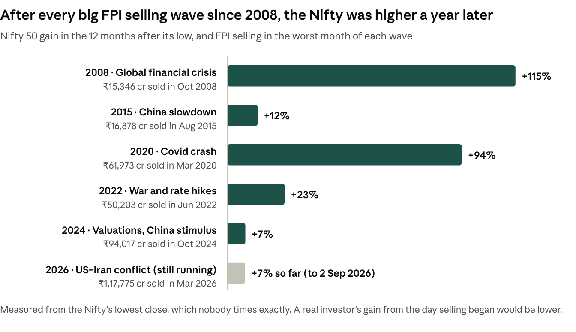
Outlook Money analysis of NSDL and NSE data, published 2 Sep 2026. Price index, before dividends.
Two honest caveats. The gains are measured from the very bottom, which no one catches exactly. And they vary widely, from 7% to 115%, so FII selling tells you nothing about how big or how quick a recovery will be.
What the pattern does show is timing. The heaviest selling has tended to come close to the low, not at the start of a long decline. People who stopped their SIPs during these months stopped buying at some of the lowest prices of the decade.
Calendar years tell a similar story. Foreign investors sold heavily in 2022 (₹1.21 lakh crore) and 2025 (₹1.66 lakh crore). The Nifty still ended 2022 slightly up and 2025 about 10.5% up, with domestic buying taking the other side.
The price fell. Did the value?
In February 2025, Damodaran called India the most expensive market in the world, at about 31 times earnings across all listed companies (Business Today). In the recent ET Now interview, he said he now feels more positive about Indian stock prices than he did then.
His distinction is worth keeping. Price is driven by mood and swings a lot. Value comes from what companies will earn over many years, and moves far less. This year, most of the change has been in price.
| Nifty 50 price-to-earnings (P/E) | Level |
|---|---|
| 23 October 2026 | 19.05 |
| 5-year average | 21.88 |
| 10-year average | 24.70 |
Only about 1 in 140 trading days since 2016 has seen a lower Nifty P/E. A lower P/E doesn’t promise a quick rebound. It does mean each rupee you invest today buys more earnings than it did in 2024.
That’s the part an SIP investor should care about. Your existing portfolio is down. But your next instalment, and every one after it, buys at today’s lower prices. As Damodaran put it, it doesn’t feel like a better deal, but it is one.
Indian investors now own more of India than foreigners do
Ten years ago, foreign funds held about a fifth of the market, more than all Indian institutions put together. That has flipped.
| Share of NSE-listed companies, June 2026 | |
|---|---|
| Domestic institutions (mutual funds, insurers, pension funds) | 19.5% |
| Foreign portfolio investors | 15.1%, lowest in about 17 years |
| Individual investors holding shares directly | 9.5% |
| Of which domestic mutual funds alone | 11.6%, a record for the 12th quarter in a row |
Domestic institutions have held a bigger share than foreigners for seven quarters in a row, a position last seen in 2003. A large part of that money is the SIPs of salaried Indians, arriving every month whatever the headlines say.
That is a big reason why a record year of foreign selling has produced a 14% fall, not a 2008-style collapse. In 2008, foreigners sold about ₹53,000 crore and the Nifty halved. In 2026 they have sold about six times that amount.
So what should you do?
Not much, and that’s the point. Here is how the two kinds of reaction compare:
| If you’re tempted to… | What the plan does instead |
|---|---|
| Stop your SIP until FIIs come back | Keep it going. By the time the headlines turn positive, prices usually have too. |
| Copy the foreign funds and sell | Remember they sell for dollar, currency and global reasons that may not apply to your rupee goals. |
| Wait for the “right time” to invest a lump sum | Decide by your asset allocation, not the news. If equity has fallen below your target share, rebalancing tops it up in a disciplined way. |
| Move everything into gold, property or a fixed deposit | Check what each goal needs. Money needed within 3 years shouldn’t be in equity anyway; long-term money can ride this out. |
| Check your portfolio every day | Review it against your goals once a quarter. |
If you’re an NRI investing from abroad: a weaker rupee means each dollar, dirham or pound you send buys more units today. Your currency risk on the way back is real, so it belongs in your plan, but it isn’t a reason to stop.
The one thing worth doing right now is a check, not a trade. Is your emergency fund in place? Is money for near-term goals out of equity? If yes, a falling market is something your plan already expected.
What I tell clients who send me the headline
When that screenshot arrives, my reply is usually some version of this:
“The people selling are managing someone else’s money in dollars, against a benchmark, with a quarterly review coming up. You are investing your own rupees for a goal that is 10 or 15 years away. You are not in the same race, so don’t run their race.”
Then we look at three things together:
- When do you need this money? If it’s more than five to seven years away, this year’s fall is a small part of the journey.
- Is the money you need soon already safe? Emergency fund and near-term goals should be out of equity anyway. If they are, nothing about FII selling touches them.
- Is your equity share still where we planned it? If the fall has pushed it below target, that’s a signal to top up, not to stop.
Most of the time, the conversation ends with the SIP running exactly as before. That isn’t stubbornness. The plan was built knowing years like this would come. My job is to make sure a headline doesn’t undo a plan that was made for 15 years, not 15 days.
If you’re unsure whether your own portfolio is built for a year like this, a planning conversation is the place to check.
Sources: Swarajya/PTI, FPI outflows Oct 2026 · Outlook Business, March record outflow · Free Press Journal, Nifty YTD · UNI, AMFI SIP data Sep 2026 · Business Today, rupee · Tapetide, Nifty PE history · Outlook Money, ownership · NSE India Ownership Tracker · Outlook Money, FPI selling and Nifty recovery · IIFL, FPI selling 2008 · Business Today, Damodaran Feb 2025 · Aswath Damodaran interview, ET Now, 2026
Aikeyam Wealth is a SEBI Registered Investment Adviser (Registration No. INA000019822). Registration granted by SEBI, membership of BASL and certification from NISM in no way guarantee performance of the intermediary or provide any assurance of returns to investors. Investments in securities markets are subject to market risks. Read all related documents carefully before investing. Figures are historical and do not indicate future returns. Views of third parties quoted here are their own. This article is educational and is not personalised advice.
Written by
Kashish Manjani
Kashish blends strategic thinking with timeless financial principles — helping clients grow, protect, and align their wealth with their values. Kashish blends strategic thinking with timeless financial principles — helping clients grow, protect, and align their wealth with their values.
Featured in The Economic Times | Host of Money Talks with Kashish on YouTube.
FAQs
Frequently Asked questions
Why are FIIs selling Indian stocks in 2026?
A mix of global and local reasons: high US bond yields, a strong dollar, high crude prices, a weaker rupee, slower earnings growth and the AI boom drawing money to the US, Korea and Taiwan. Many of these are about global portfolios, not about Indian companies alone.
Does FII selling mean the market will keep falling?
Not on its own. FII flows mostly reflect what has already happened. In past selling waves (2008, 2020, 2022, 2024) the Nifty was higher a year after its low, though how much varied widely and the timing could not be predicted.
Should I stop my SIP when foreign investors are selling?
Usually not. An SIP is built to keep buying through falls, and a lower market means each instalment buys more units. Review it against your goal’s time horizon, not against monthly FII data.
What is the difference between FII and DII?
FIIs, or FPIs, are foreign investors such as overseas funds. DIIs are Indian institutions such as mutual funds, insurers and pension funds. Since 2025, DIIs have owned a larger share of NSE-listed companies than FPIs.
Is the Indian stock market cheap now?
The Nifty 50’s P/E was about 19 in late October 2026, below its 5-year average of about 22 and 10-year average of about 25. That’s closer to fair than expensive, but valuations alone don’t tell you when a market will turn.
How does a weak rupee affect my mutual funds?
For a resident investing in rupees, it mostly matters through companies’ earnings and FII flows. For an NRI, it cuts both ways: money sent now buys more units, but returns are worth fewer dollars if the rupee stays weak when you take money back.