
How to Build a Family Financial Safety Net: Emergency Funds, Insurance and Investments

Written by
Kashish Manjani
- Blog
- Financial Planning
Date
28 October 2026
YouTube
A medical bill, a job loss or an urgent home repair rarely comes with a warning. When it does arrive, the families who cope best are not necessarily the richest. They are the ones who planned for it. Family financial planning is the habit of building protection first and growth second, so that one bad month never forces you to sell your investments or borrow at high interest.
This guide shows you how to build a safety net in three layers: an emergency fund, the right insurance, and investments that stay untouched. You will also find a worked example, a comparison table and a simple flowchart to decide what to do first.
Quick answer: Insure first, then save three to six months of essential expenses (more if you are self-employed or support dependents), then invest the rest for the long term.
Why Every Family Needs a Safety Net
Without a plan, an emergency leaves you three poor choices: redeem long-term investments at a bad time, swipe a credit card that can charge roughly 24% to 42% a year, or borrow from relatives. A safety net removes that pressure. It protects your goals, such as your child’s education and your retirement, from being derailed by a short-term shock.
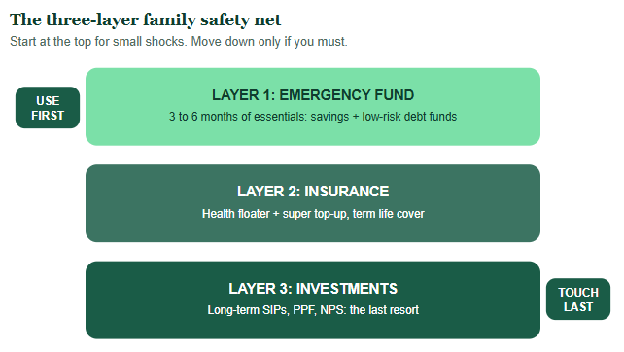
Think of it as a three-layer shield:
- Emergency fund for everyday surprises and income gaps
- Insurance for large, catastrophic costs
- Investments for long-term growth, kept as the last resort
Layer 1: Build Your Emergency Fund
An emergency fund is money set aside only for unplanned, essential needs. It is not for holidays, gadgets or festive shopping.
How much should you save?
The common rule is three to six months of essential expenses, but your situation changes the number.
| Your situation | Suggested emergency fund |
|---|---|
| Salaried, stable job, one or two earners | 3 to 6 months of essential expenses |
| Single income with dependents | 6 to 9 months of essential expenses |
| Self-employed or irregular income | 6 to 12 months of essential expenses |
| Retired | Enough to cover healthcare and short-term needs without touching the corpus |
The simple formula
Emergency fund = Monthly essential expenses x Months of cover
Essentials include rent or EMI, groceries, utilities, school fees, insurance premiums, transport and loan repayments. Leave out dining out, subscriptions and travel.
Example: A family spends ₹70,000 a month on essentials and wants six months of cover. Target = ₹70,000 x 6 = ₹4.2 lakh.
Where should you keep it?
Do not park the entire amount in one place. Split it by how fast you may need it:
| Bucket | Share of the fund | Where to keep it | Access time |
|---|---|---|---|
| Immediate cash | 1 to 2 months | Savings account or sweep-in FD | Instant |
| Short-term reserve | Remaining months | Liquid, overnight or ultra-short debt funds, or short FDs | Same day to 2 working days |
For the ₹70,000 family above, that could mean ₹1.4 lakh in a savings account (two months) and ₹2.8 lakh in a low-risk debt fund (four months). For help choosing, read Aikeyam’s guide to the best debt mutual funds in India. Debt funds carry some risk and are not guaranteed, so check the scheme’s risk level on the AMFI website first.
Start small, automate it
You do not need the full amount on day one. Set up an automatic monthly transfer on salary day and treat it like a bill. Add bonuses and tax refunds when they arrive. If you want to see how a regular monthly amount adds up, try Aikeyam’s SIP Calculator.
Layer 2: Get the Right Insurance
An emergency fund covers small and medium shocks. It cannot cover a major hospitalisation or the loss of an earning member. That is the job of insurance, which transfers big risks to an insurer for a small yearly premium. Insurers in India are regulated by IRDAI, so check the claim settlement record before you buy.
| Cover | Who needs it | Commonly suggested level |
|---|---|---|
| Health insurance (family floater) | Every family | Often ₹10 lakh to ₹25 lakh, depending on city and family size; add a super top-up for extra cover |
| Term life insurance | Anyone with dependents or loans | Often 10 to 15 times annual income |
| Personal accident cover | People who travel often or do physical work | Optional add-on |
| Parents’ health cover | If you support elderly parents | Separate policy, as premiums rise with age |
A few tips:
- Buy early. Premiums are lower and pre-existing conditions are less of a problem when you are young and healthy.
- Keep insurance separate from investment. Pure term and health plans give the most cover for the money.
- Review yearly. A new child, a home loan or a career jump all change how much cover you need.
- Check tax benefits. Health insurance premiums may qualify for a deduction under Section 80D, subject to your tax regime. See the Income Tax Department for current rules.
Not sure how much cover is right?
Aikeyam’s insurance planning service can help you size it to your family’s goals.
Layer 3: Invest the Rest, and Leave It Alone
Once your emergency fund and insurance are in place, the rest of your savings can work harder. Your long-term investments, such as equity mutual funds, PPF and NPS, are meant for goals that are five or more years away.
The key rule is that investments are the last resort, not the first. Selling during a market dip locks in losses, may trigger capital gains tax and breaks the compounding that builds wealth. If you have built layers one and two properly, you should rarely need to touch them.
| Goal | Typical time frame | Suitable approach |
|---|---|---|
| Emergency buffer | Anytime | Savings and low-risk debt funds |
| Child’s education | 8 to 15 years | Equity mutual fund SIPs, gradually moving to safer assets as the goal nears |
| Retirement | 15 to 30 years | Equity funds, PPF, NPS |
| Home down payment | 3 to 7 years | Mix of debt and hybrid funds |
Wondering how to split a large monthly surplus? Read How to Invest ₹2 Lakh Per Month for Long-Term Wealth. For a plan built around your goals, see Aikeyam’s investment planning and management service. All investments are subject to market risk, so read scheme documents and use SEBI-registered advisers.
Where Should You Start? A Simple Flowchart
If you are unsure what to tackle first, follow this order:
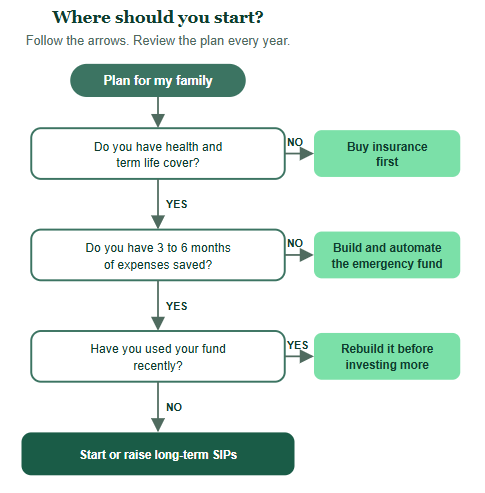
- No health or term cover? Get insurance first.
- Emergency fund below three months? Build it before increasing investments.
- Fund and cover in place? Start or increase long-term SIPs.
- Used the fund? Rebuild it before investing more.
- Life changed? Review everything once a year.
Common Family Financial Planning Mistakes
- Waiting for a large amount to start. Even ₹2,000 a month builds a habit.
- Keeping too much in a savings account. Beyond about six months, extra cash loses to inflation.
- Skipping insurance to save on premiums. One hospital stay can cost more than a decade of premiums.
- Mixing the emergency fund with spending money. Keep it in a separate account.
- Relying on credit cards. High interest turns a short-term problem into a long-term one.
- Never reviewing the plan. Rising prices and growing families mean your numbers must change.
Your 30-Day Action Plan
- Week 1: List your essential monthly expenses and calculate your target.
- Week 2: Check existing health and term cover and fix the gaps.
- Week 3: Open a separate savings account and automate a monthly transfer.
- Week 4: Start a debt fund for the short-term reserve and a SIP for long-term goals.
Final Thoughts
A strong family financial plan is not about complicated products. It is about order: protect first, save second, invest third. Build the layers one at a time, review them every year, and you will face surprises with confidence instead of panic. If you would like a plan tailored to your family, our guide to choosing a financial advisor in India is a good place to begin.
Ready to protect your family's future?
Book your free Clarity Call with Aikeyam’s SEBI-registered advisers and get personalised financial guidance, with no commitment needed. You can also explore our Financial Planning services.
Disclaimer: This article is for educational purposes only and is not investment, insurance or tax advice. Mutual fund investments are subject to market risks. Figures are illustrative. Please consult a qualified adviser before making decisions.
Written by
Kashish Manjani
Kashish blends strategic thinking with timeless financial principles — helping clients grow, protect, and align their wealth with their values. Kashish blends strategic thinking with timeless financial principles — helping clients grow, protect, and align their wealth with their values.
Featured in The Economic Times | Host of Money Talks with Kashish on YouTube.
FAQs
Frequently Asked questions
How much emergency fund does a family need?
Most families should aim for three to six months of essential expenses. Single-income households, families with dependents and the self-employed should aim higher, between six and twelve months.
Should I build an emergency fund or buy insurance first?
Start with health and term insurance, because they cover costs an emergency fund cannot. Then build your fund, ideally in parallel with a small monthly transfer.
Where is the best place to keep an emergency fund?
Keep one to two months in a savings account for instant access and the rest in low-risk options such as liquid or ultra-short debt funds or short FDs. Avoid equity for this money.
Can I use my investments in an emergency?
Yes, but only as a last resort. Redeeming investments early can mean losses, taxes and lost compounding.
What is Health Insurance?
Health insurance Pays your medical bills, such as hospitalisation and surgery, up to the sum insured, either cashless at network hospitals or by reimbursement.
What is Term Insurance?
Term insurance is pure life cover. If you die during the policy term, your nominee gets a fixed lump sum. If you outlive the term, nothing is paid (unless you chose a return-of-premium plan).
What is the difference between health insurance & term insurance?
Health insurance covers your treatment costs while you’re alive. Term insurance covers your family’s income if you’re not. Most families need both.