
How to Generate Retirement Income in India Without Running Out of Money

Written by
Kashish Manjani
- Blog
- Financial Planning
Date
06 October 2026
YouTube
Retirement income planning in India means turning a one-time corpus into a monthly “salary” that rises with inflation and lasts 30 years or more. The most dependable way to do it is to give every rupee one of three jobs (cover near-term spending, provide stable income, or grow for later) and to start withdrawals at 3% to 3.5% of the corpus rather than the 4% rule imported from the US.
Most people spend decades learning to save and almost no time learning to spend. That gap is where retirement plans fail. This guide, prepared by the Aikeyam team (a SEBI-registered, fee-only investment adviser), explains how to balance regular withdrawals, liquidity, inflation protection and growth, with illustrative scenarios and a checklist you can use today.
Why Retirement Income Is Harder Than Saving for Retirement
Four risks shape every retirement income plan:
- Longevity. Someone retiring at 60 may need income until 90, so the plan has to last 30 years or more.
- Inflation. India’s retail inflation was 4.82% in August 2026, above the RBI’s 4% medium-term target, and medical costs often rise faster than the headline figure.
- Sequence risk. A market fall in the first few years hurts more when you are also withdrawing money.
- Liquidity shocks. Hospital bills and family needs rarely arrive on schedule.
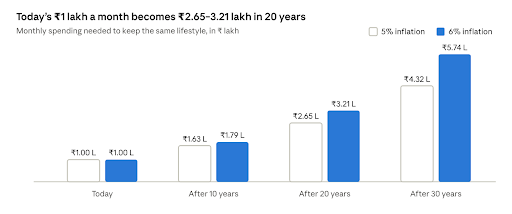
Inflation is the quiet one. Here is what ₹1 lakh of monthly spending becomes:
| After | At 5% inflation | At 6% inflation |
|---|---|---|
| Today | ₹1.00 lakh | ₹1.00 lakh |
| 10 years | ₹1.63 lakh | ₹1.79 lakh |
| 20 years | ₹2.65 lakh | ₹3.21 lakh |
| 30 years | ₹4.32 lakh | ₹5.74 lakh |
A fixed payout therefore loses half its buying power in roughly 12 to 14 years. Retirement income has to grow, which is why a plan made only of fixed deposits is risky.
How Much Can You Safely Withdraw?
The 4% rule says you can withdraw 4% of your corpus in year one and raise that amount with inflation every year. It comes from US research on 30-year retirements in a low-inflation economy. Because India’s inflation and market volatility differ, many planners suggest starting closer to 3% to 3.5%.
The arithmetic is simple. Divide 100 by your withdrawal rate to get the corpus multiple: 3.5% needs about 29 times your annual spending, and 3% needs about 33 times. A household spending ₹6 lakh a year would need roughly ₹1.7 crore to ₹2 crore. Treat that as a starting point, not a promise. Your health, other income and willingness to trim spending in a bad year all move the number, and a simple guardrail, such as skipping the inflation step-up after a poor market year, can make a plan more durable.
The 3-Bucket Plan: Spend, Stabilise, Grow
A bucket plan separates money by the job it does, so a market fall never forces you to sell growth assets to pay this month’s bills.
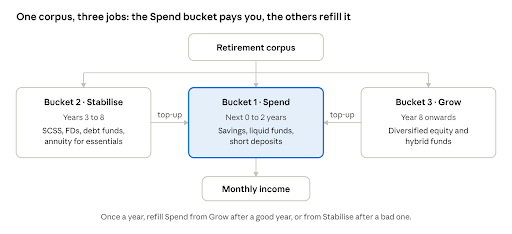
- Bucket 1, Spend (0 to 2 years of expenses). Savings account, liquid funds and short deposits. This is your “salary account”.
- Bucket 2, Stabilise (roughly years 3 to 8). Senior Citizen Savings Scheme, laddered deposits, high-quality debt funds and, if you want certainty, an annuity for essential costs.
- Bucket 3, Grow (year 8 onwards). Diversified equity and hybrid funds, the only bucket built to outpace inflation over decades.
Once a year, top up Bucket 1: from Bucket 3 after a good year, and from Bucket 2 after a bad one. That single rule is what keeps withdrawals steady.
Choosing the Right Instruments
| Instrument | Main job | Inflation protection | Liquidity | Worth knowing |
|---|---|---|---|---|
| Savings, liquid funds, short FDs | Spend | Low | High | Check deposit-insurance limits per bank |
| Senior Citizen Savings Scheme | Stabilise | Low | Medium | 8.2% for Oct–Dec 2026 on new deposits; 5-year term; up to ₹30 lakh |
| Annuity or NPS annuity | Stabilise | Low | Low | Lifetime payout; fixed amounts lose real value |
| SWP from mutual funds | Spend and stabilise | Medium | High | Only the gains in each withdrawal are taxed |
| Equity and hybrid funds | Grow | High | High, but volatile | Needs a 7 to 10 year view |
On the NPS, non-government subscribers with a corpus above ₹12 lakh can take up to 80% as a lump sum and must annuitise at least 20%, and the exit age is now 85 (PFRDA, December 2025).
On tax, interest from deposits and SCSS is taxed at your slab, while the TDS threshold on interest for senior citizens is ₹1 lakh a year, and Form 15H can stop TDS when your tax is nil. Rules moved to the Income-tax Act, 2025 from April 2026, so confirm current provisions on incometax.gov.in or with a chartered accountant.
Three Illustrative Retirement-Income Scenarios
These are simplified, hypothetical examples to show the logic. They are not forecasts or recommendations.
| Scenario | Corpus | Spending a year | Starting withdrawal | Spend / Stabilise / Grow | Takeaway |
|---|---|---|---|---|---|
| A: Comfortable | ₹3 crore | ₹8 lakh | 2.7% | ₹16 L / ₹64 L / ₹2.2 cr | Room for a little more spending or a legacy; keep the growth bucket intact |
| B: Workable | ₹1.8 crore | ₹6 lakh | 3.3% | ₹12 L / ₹60 L / ₹1.08 cr | A ₹30 lakh SCSS deposit pays about ₹2.46 lakh a year; use guardrails |
| C: Shortfall | ₹1.2 crore | ₹6 lakh | 5.0% | ₹12 L / ₹36 L / ₹72 L | Too high to sustain as is; close the gap first |
Scenario C shows why the withdrawal rate matters more than the corpus size. At 3.5%, ₹6 lakh of spending needs about ₹1.7 crore, a gap of roughly ₹50 lakh. The levers are to trim spending to around ₹4.2 lakh, work or delay retirement by a few years, cover essentials with pension or annuity income, or use rental income. Often a mix works best.
Withdrawal-Planning Checklist
☐ Split annual spending into essential and discretionary costs
☐ Choose a starting withdrawal rate (3% to 3.5% is a prudent range) and test it with 6% inflation
☐ Fund Bucket 1 with 12 to 24 months of expenses
☐ Add up guaranteed income (pension, SCSS, annuity, rent) and compare it with essential costs
☐ Keep adequate health insurance plus a separate medical reserve
☐ Set a refill date and rule, such as the same date every year
☐ Plan which account you withdraw from first, with tax in mind, and submit Form 15H if eligible
☐ Add nominees, joint holders and a will, and share the plan with your spouse
☐ Review yearly, and revisit the withdrawal rate every two to three years
5 Mistakes That Make Retirement Money Run Out
- Relying only on fixed deposits. Safe on paper, but inflation erodes the real income.
- Keeping withdrawals fixed forever. Spending grows, so the plan must too.
- Going all-equity or no-equity. Both extremes break the bucket logic.
- Ignoring medical costs. They tend to rise with age.
- Selling equity during a crash to fund expenses. Bucket 1 exists to prevent exactly this.
Final Words: Build Income, Don't Guess It
A retirement that lasts is built on three habits: a sustainable starting rate, buckets that match money to its job, and a yearly review. Start with the checklist above and test your own numbers.
Written by
Kashish Manjani
Kashish blends strategic thinking with timeless financial principles — helping clients grow, protect, and align their wealth with their values. Kashish blends strategic thinking with timeless financial principles — helping clients grow, protect, and align their wealth with their values.
Featured in The Economic Times | Host of Money Talks with Kashish on YouTube.
FAQs
Frequently Asked questions
How much corpus do I need to retire in India?
As a rule of thumb, 29 to 33 times your first-year annual spending, depending on whether you use a 3.5% or 3% withdrawal rate. Pension and other income can lower the number.
Is an SWP better than an annuity?
Neither wins universally. An annuity gives certainty but a fixed payout, while an SWP is flexible but market-linked. Many retirees use an annuity or SCSS for essentials and an SWP for the rest.
Should retirees keep money in equity?
Usually some, because income must keep up with inflation over 30 years. The share depends on your plan and risk comfort.
How often should I review the plan?
Refill Bucket 1 yearly, review the withdrawal rate every two to three years, and revisit after any big life event.