
Gold ETF vs Gold Mutual Fund: Which Is Better for Your Portfolio?

Written by
Kashish Manjani
- Blog
- Investment
Date
28 October 2026
YouTube
Gold has been a household favourite in India for generations, but buying jewellery or coins is no longer the only way to own it. Today, you can hold gold in paper form through two popular routes: the gold ETF and the gold mutual fund. The Gold ETF vs gold mutual fund question confuses many investors, because both track the price of gold and look almost identical on the surface.
The differences, however, show up in your costs, your tax bill and the way you invest. This guide breaks them down in plain language so you can choose the option that fits your portfolio.
Quick answer: Choose a gold ETF if you already have a demat account, want the lowest costs and may sell within 12 to 24 months. Choose a gold mutual fund if you have no demat account and want to invest through a small monthly SIP.
What Is a Gold ETF?
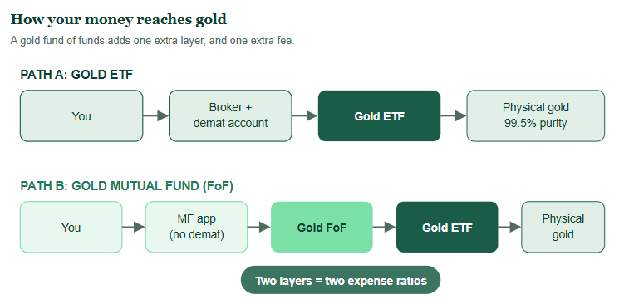
A gold exchange-traded fund (ETF) is a fund that tracks the domestic price of gold and trades on the stock exchange just like a share. According to HDFC Mutual Fund, a gold ETF invests in physical gold of 99.5% purity or higher, as prescribed by SEBI. You buy and sell units through your broker during market hours, and the price moves with the gold price through the day.
What Is a Gold Mutual Fund?
A gold mutual fund is technically a fund of funds (FoF). Instead of buying gold itself, it invests your money in units of one or more gold ETFs. Because it is a regular mutual fund scheme, you can buy it through any mutual fund app or platform without a demat account, and you can start a SIP with a small amount.
The trade-off is a second layer of cost: you pay the FoF’s expense ratio on top of the expense ratio charged by the underlying gold ETF.
Gold ETF vs Gold Mutual Fund: Key Differences
| Feature | Gold ETF | Gold Mutual Fund (FoF) |
|---|---|---|
| Structure | Tracks gold price; holds physical gold | Invests in gold ETF units |
| Demat account | Required | Not required |
| How you buy | Stock exchange, during market hours | Mutual fund platform, at end-of-day NAV |
| SIP | Available only through some brokers | Easily available, often from small amounts |
| Minimum investment | Price of one unit | Low; many funds allow small SIPs |
| Expense ratio | Lower | Higher (fund cost plus ETF cost) |
| Extra charges | Brokerage and demat charges | Exit load may apply on early exit |
| Long-term holding period (tax) | More than 12 months | More than 24 months |
| Liquidity | Sell on exchange when markets are open | Redeem at NAV; proceeds take a few working days |
Cost Comparison: Why Expense Ratios Matter
Gold ETFs are passive, so their expense ratios are generally low. Gold mutual funds charge their own expense ratio on top of the ETF’s, so the total cost is higher. On a small holding for a short period, the gap looks tiny. Over 10 or 15 years, even a difference of half a percentage point can eat into your returns noticeably.
ETF investors should also factor in brokerage, demat charges and the bid-ask spread, which is the small gap between the buying and selling price on the exchange. Check the fund’s trading volume and tracking error before you buy.
Taxation: The Biggest Practical Difference
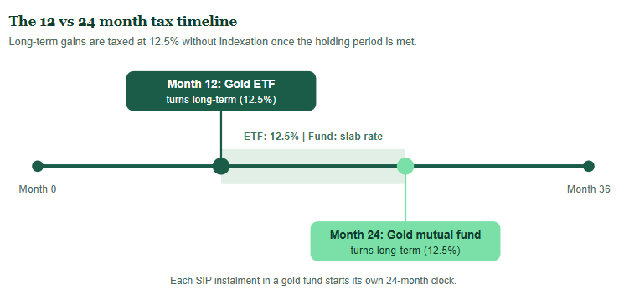
Taxation is where the two options really split. Based on the current rules reported by HDFC Mutual Fund and Bajaj Finserv, the long-term holding period is different for each:
| Point | Gold ETF | Gold Mutual Fund (FoF) |
|---|---|---|
| Long-term if held for | More than 12 months | More than 24 months |
| Tax on long-term gains | 12.5% without indexation | 12.5% without indexation |
| Tax on short-term gains | As per your income tax slab | As per your income tax slab |
Illustration: Suppose you earn a ₹1,00,000 gain and sell after 18 months. A gold ETF holder pays the 12.5% long-term rate, which is ₹12,500. A gold FoF holder is still within the short-term period, so the gain is taxed at their slab rate. At a 30% slab, that is ₹30,000. (Figures exclude surcharge and cess.)
This makes gold ETFs more tax-efficient for anyone who expects to hold for between 12 and 24 months. If you plan to stay invested for more than two years anyway, the tax gap disappears. Also remember that every SIP instalment in a gold fund has its own holding period, so each one must age separately.
Tax rules change often, so confirm the latest position on the Income Tax Department website or with a tax professional before you act.
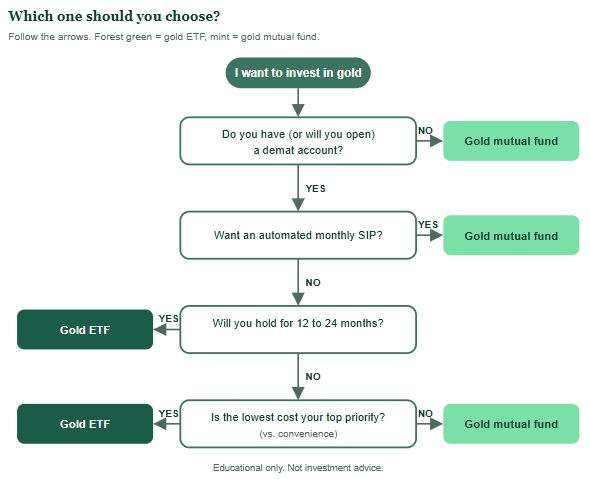
Which One Should You Choose? A Simple Flowchart
Use this decision path to find your match:
Who Should Pick a Gold ETF?
A gold ETF suits you if you:
- Already trade stocks and have a demat account
- Want the lowest expense ratio
- Might sell within two years and want long-term tax treatment after 12 months
- Are comfortable watching prices during market hours
Who Should Pick a Gold Mutual Fund?
A gold mutual fund suits you if you:
- Do not have, or do not want, a demat account
- Prefer a disciplined, automated monthly SIP
- Are a first-time investor who wants a simple app-based experience
- Plan to stay invested for more than 24 months
Want to see what a monthly gold SIP could build over time? Try our SIP Calculator.
Common Mistakes to Avoid
- Ignoring the holding period. Selling a gold FoF at month 20 can cost you far more tax than selling an ETF at the same point.
- Overlooking total cost. Compare the full expense ratio, plus brokerage for ETFs, not just the headline number.
- Buying ETFs with low volumes. Thinly traded units can have wider bid-ask spreads.
- Over-allocating to gold. Gold does not generate income and can stay flat for years.
- Confusing gold ETFs with gold mining funds. Some overseas funds hold gold-mining company shares, which behave more like equities than gold.
How Much Gold Should Be in Your Portfolio?
Most financial planners suggest keeping gold as a diversifier rather than a core holding, often in the range of 5% to 15% of your portfolio, depending on your goals and risk appetite. Gold has historically helped cushion portfolios during inflation and market stress, which is the reason to own it. For global context on gold demand and trends, see the World Gold Council. Both ETFs and FoFs are regulated by SEBI, and you can check fund details and NAVs on AMFI.
Final Verdict: Gold ETF vs Gold Mutual Fund
Neither option is universally better. A gold ETF wins on cost and on earlier long-term tax treatment (12 months). A gold mutual fund wins on convenience, since it needs no demat account and works neatly with SIPs. For a long-term investor who is happy to hold for over two years, the choice mostly comes down to how you prefer to invest, and the convenience of a fund can outweigh its slightly higher cost.
Ready to add gold to your portfolio?
Open a demat account to buy gold ETFs, or start a gold fund SIP today. Not sure which suits you? Talk to our investment experts for a free consultation.
Related Reads:
Disclaimer: This article is for educational purposes only and is not investment or tax advice. Gold ETFs and gold mutual funds are subject to market risks. Tax rules and expense ratios may change, so please read scheme documents and consult a qualified advisor.
Written by
Kashish Manjani
Kashish blends strategic thinking with timeless financial principles — helping clients grow, protect, and align their wealth with their values. Kashish blends strategic thinking with timeless financial principles — helping clients grow, protect, and align their wealth with their values.
Featured in The Economic Times | Host of Money Talks with Kashish on YouTube.
FAQs
Frequently Asked questions
Is a gold ETF better than a gold mutual fund?
It depends on your needs. A gold ETF generally has lower costs and a shorter long-term holding period for tax, while a gold mutual fund offers SIP convenience without a demat account.
Can I start a SIP in a gold ETF?
Some brokers offer SIP-style purchases for ETFs, but it is not as seamless as a SIP in a gold mutual fund, which is available on almost every mutual fund platform.
How is a gold mutual fund taxed?
Gains are long-term only after more than 24 months, taxed at 12.5% without indexation. Earlier gains are taxed at your slab rate.
Is investing in gold ETFs and gold funds safe?
Both are regulated by SEBI and back your investment with 99.5% pure gold (directly or through the underlying ETF). They still carry market risk, since gold prices can fall.