
Your Nominee Is Not Your Heir: Why Every Indian Family Needs a Will

Written by
Kashish Manjani
- Blog
- Investment
Date
24 November 2026
YouTube
A client in his late thirties asked me something I hear often:
“I’ve added nominees to every bank account, every mutual fund, my demat. Isn’t that enough? Why do I need a will?”
It’s a reasonable thing to believe. Banks and fund houses ask for a nominee at every step, so it feels like the job is done.
It isn’t. In India, a nominee is a caretaker, not an owner. Without a will, your family may need court paperwork, months of waiting and every legal heir’s signature before they can touch what you built. A will written in a single day can avoid almost all of that.
Here is what actually happens, and what to put in place.
A nominee is a caretaker, not an owner
In December 2023, the Supreme Court settled this in Shakti Yezdani v. Jayanand Jayant Salgaonkar. It held that a nominee of shares and securities does not become the absolute owner. The nominee holds the assets in trust for the legal heirs, and succession law decides who those heirs are (judgment summary). Courts have long taken the same view for bank deposits.
| Nominee | Legal heir (or person named in your will) | |
|---|---|---|
| Role | Collects the asset from the bank, fund house or depository | Owns the asset |
| Can they keep it? | Only if they are also the heir or named in the will | Yes |
| What the institution does | Pays the nominee and is legally discharged | Has no further obligation once it has paid the nominee |
| What if the nominee keeps it anyway? | The heirs can claim it from the nominee, often through court | — |
So if your wife is your nominee but your mother is also a legal heir, your wife receives the money, but she may legally owe a share of it to your mother.
From 1 November 2025, banks let you name up to four nominees per account or locker, with set percentages. That makes payouts smoother. It still doesn’t decide ownership.
The fix is simple: make your nominations and you will say the same thing. The nominee collects the money, and they will confirm that they get to keep it.
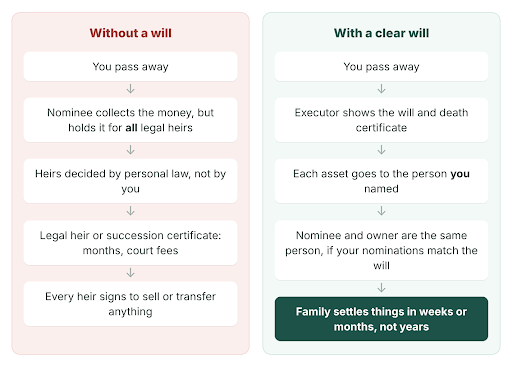
What your family goes through, with and without a will
| No will | A clear will | |
|---|---|---|
| Who decides who gets what | Your personal law, based on religion and relationship | You |
| Small balances | Often released to the nominee with an indemnity and the heirs’ consent | Same, and faster |
| Larger balances, shares, mutual funds | Institutions may ask for a legal heir certificate or a court-issued succession certificate | The will plus the death certificate and executor’s documents, in most cases |
| Time | Several months to a year or more for court certificates | Usually weeks to a few months |
| Cost | Court fees in many states are linked to the value of the assets, plus lawyer fees | Mostly paperwork |
| Who must sign to sell or transfer a property | Every legal heir | The person the will names, through the executor |
| Risk of family dispute | High: everyone owns a share of everything | Lower: each asset has a named owner |
The exact limits, documents and fees vary by bank, fund house and state. The pattern doesn’t: without a will, your family has to prove who they are before they can collect what is theirs.
Without a will, the law picks your heirs, and splits everything
When there’s no will, your religion decides who inherits. Hindus, Sikhs, Jains and Buddhists follow the Hindu Succession Act, 1956. Christians and Parsis follow the Indian Succession Act, 1925. Muslims follow Muslim personal law.
Take a common case: a married Hindu man, survived by his mother, his wife and two children.
| Family member | Share without a will |
|---|---|
| Mother | 25% |
| Wife | 25% |
| Child 1 | 25% |
| Child 2 | 25% |
| Father | Nothing, as long as any of the four above is alive |
| Brothers and sisters | Nothing |
The bigger problem is that each heir owns 25% of every asset, not one whole asset each. The flat, the mutual funds and the bank balance are all jointly owned. To sell or rent the flat, all four must agree and sign. If one of them refuses, or simply lives abroad and is slow with paperwork, everything waits.
It compounds across generations. An estate-planning specialist I work with described a single plot of land with 16 legal owners: a grandfather died without a will, then one of his sons died without one too, and his share passed to his widow and children. The family had long agreed who should get the plot. On paper, they still needed 16 signatures to transfer it.
Simple, notarised or registered: which will you need?
All three are legally valid. A will doesn’t need stamp paper. It must be in writing, signed by you, and signed by two witnesses who saw you sign (section 63, Indian Succession Act, 1925).
| Type | What it involves | Worth it when |
|---|---|---|
| Simple will | Signed at home in front of two witnesses | Your family is likely to agree with how you’ve split things. This covers most households. |
| Notarised will | The same document, stamped by a notary | Rarely. It adds little legal weight beyond a simple will. |
| Registered will | You and two witnesses sign before the Sub-Registrar, who keeps a copy | You expect a family member might object, there’s any risk of forgery, or the estate is large |
Registration is optional under section 18 of the Registration Act, 1908. It makes the will harder to challenge, but every later change also has to be registered, which means another trip with two witnesses. Registering also doesn’t help your family find the will. They still need to know where it is and have its registration number.
What about probate?
Probate is a court order confirming a will. Until recently it was mandatory for wills by Hindus, Sikhs, Jains, Buddhists and Parsis covering property in Mumbai, Chennai or Kolkata. The Repealing and Amending Act, 2025 removed that requirement from December 2025. Probate is now optional everywhere, though a bank, housing society or registrar may still ask for it, and it remains useful when a will is disputed.
Simple steps that make any will stronger:
- Write a short paragraph in your own handwriting confirming the will is yours and made freely.
- Video-record the signing, with both witnesses visible.
- Date and number every page, and initial each one.
- Store the original somewhere safe, and tell your executor exactly where it is.
What goes into a good will
The whole point of a will is to remove guesswork. Every section should leave no doubt about who you are, what you own and who gets it.
| Part of the will | What to include | Why it matters |
|---|---|---|
| You | Full name, address, PAN, Aadhaar | No doubt about whose will it is |
| Your family | Spouse, children, parents, with ages and ID details | No surprise claimants later |
| Your assets | Identifiers, not values: account numbers and IFSC, folio numbers, demat ID, property address and survey number | Values change; identifiers don’t |
| Who gets what | One owner per asset where possible; percentages where an asset must be shared | Stops arguments over “the front half” or “the ground floor” |
| A dispute clause | For example: if shared owners can’t agree, sell the asset and split the money | One heir can’t block the others |
| Executor, and a backup | The person who signs on your behalf after you’re gone | Someone has legal authority to act |
| Residuary clause | Who gets everything you didn’t list, including assets bought later | New or forgotten assets still have an owner |
| Two witnesses | Adults who saw you sign; their names, addresses and ID | Required for the will to be valid |
A few points people often get wrong:
- Don’t write amounts. “Give ₹5 lakh from my HDFC account to my nephew” fails if the account holds ₹50,000 on the day. Name the asset or a percentage instead.
- Choose your biggest beneficiary as executor. A professional executor can work, but may charge fees and add a third party. A spouse or adult child who inherits most of the estate is usually the most motivated to finish the job. Always name a backup.
- Don’t make a beneficiary a witness. The will stays valid, but the gift to that witness, or to their spouse, is void (section 67, Indian Succession Act). Pick two neutral adults.
- Selling an asset doesn’t cancel the will. Only the line about that asset stops working. The rest stands, and the residuary clause catches anything new.
- Review it every three to four years, and after any marriage, birth, death, divorce or major change in your assets.
Secure Your Retirement, Protect Your Family's Future.
Plan your retirement with Aikeyam and build a financial future that takes care of you and your loved ones.
What a will can’t do
A will is powerful, but it has limits. Knowing them avoids nasty surprises.
| Situation | What happens | What to do instead |
|---|---|---|
| Life insurance | If you name your spouse, children or parents as nominees, the Insurance Act (section 39(7)) treats them as beneficial nominees. Courts have differed on whether other heirs can still claim. | For spouses and children, buy term cover under the Married Women’s Property Act. The money then goes to them and can’t be claimed by creditors or other heirs. List all policies in your will for information. |
| Loans and debts | You can’t make someone else responsible for your debts. Debts are paid from your estate before anything is distributed. Heirs aren’t personally liable beyond what they inherit. | List every loan in the will, and say which account or asset should clear it. |
| Ancestral or HUF property | You can only bequeath your own share, not the whole property. | Get clarity on what is self-acquired and what isn’t before you write. |
| Muslim personal law | A Muslim can bequeath only up to one-third of the estate by will, and not to an heir, unless the other heirs consent. | Take advice from someone who knows Muslim personal law. |
| US shares, RSUs and US bank accounts | An Indian will not reduce US estate tax. For Indian residents who aren’t US citizens, only the first $60,000 of US assets is exempt, and the tax can reach 40% above that. | Plan US holdings separately. More on this in our next post. |
That last row matters for many salaried professionals and NRIs. If a large part of your wealth sits in RSUs of a US-listed employer, a will in India is necessary but not enough.
Will or trust?
A will is a one-time handover: when you pass away, assets move to the people you named, and the job is done. A private trust can keep managing money for years, under rules you set.
| Will | Private trust | |
|---|---|---|
| How assets pass | Once, after death | Over time, by your rules, and can start while you’re alive |
| Conditions | Simple ones | Detailed: monthly income, age-based release, use without ownership |
| Effort and cost | Low | Higher: drafting, registration, trustees, ongoing records |
| Can be changed | Any time, by a new will | Depends on how it’s set up |
| Best for | Most families | A family member with special needs; young children whose guardians you don’t fully trust; very large or complex estates |
Before you write your will: a checklist
- List every asset with its identifier: bank accounts, FDs, mutual fund folios, demat and broker accounts, EPF and NPS, property, gold, vehicles, ESOPs and RSUs, overseas accounts.
- List every loan and liability, and every insurance policy with its nominee.
- Check that each nomination matches what you plan to write in the will.
- Collect PAN and Aadhaar for yourself, each beneficiary, the executor and the witnesses.
- Decide who gets what. Prefer one owner per asset; use percentages only where you must.
- Choose an executor and a backup, and ask them first.
- Choose two witnesses who are not beneficiaries.
- Decide simple or registered.
- Sign, store the original safely, and tell your executor where it is.
- Put a review date in your calendar three to four years from now.
Where a financial planner fits.
The hardest part of a will isn’t the legal drafting. It’s the list: knowing everything you own, how each asset is held, how the nominations line up, and what your family will actually need. At Aikeyam, estate planning is part of the financial plan. We map your assets, nominations and goals, flag cross-border issues such as US holdings, and work alongside a legal partner who drafts and executes the will.
Is Your Family's Financial Future Protected?
Organise your assets, nominations and estate plan with expert guidance from Aikeyam.
Written by
Kashish Manjani
Kashish Manjani
CFP®, CTEP · Co-founder, Aikeyam
Kashish co-founded Aikeyam, a fee-only SEBI Registered Investment Adviser. Over nine years of advising, including as AVP, Financial Advisory at a SEBI-registered adviser, she has worked with 400+ families across firms, many of them NRIs and returning Indians, on plans that span India and abroad.
Featured in The Economic Times | Host of Money Talks with Kashish on YouTube.
FAQs
Frequently Asked questions
Is a nominee the legal owner after death in India?
No. In Shakti Yezdani v. Jayanand Jayant Salgaonkar (2023), the Supreme Court held that a nominee holds the assets in trust for the legal heirs. The heirs, or the people named in a valid will, are the owners. Life insurance with a spouse, child or parent as nominee is treated differently under section 39(7) of the Insurance Act.
Is a handwritten will on plain paper valid in India?
Yes. It doesn’t need stamp paper, a notary or registration. It must be signed by you and by two witnesses who saw you sign.
Is it mandatory to register a will?
No. Registration is optional. It makes the will harder to challenge and is worth considering if you expect objections or the estate is large.
Is probate still required in Mumbai, Chennai or Kolkata?
Not since December 2025, when the Repealing and Amending Act, 2025 removed section 213 of the Indian Succession Act. Some institutions may still ask for it, and it helps if a will is disputed.
Can a beneficiary be a witness to my will?
They can sign, but the gift to that witness, or to their spouse, becomes void. Use two neutral witnesses.
What happens if I sell an asset mentioned in my will?
Only that line stops working. The rest of the will stays valid, and a residuary clause covers assets you didn’t list or bought later.
How often should I update my will?
Every three to four years, and after any marriage, birth, death, divorce or major change in your assets.
How often should I update my will?
Every three to four years, and after any marriage, birth, death, divorce or major change in your assets.
Kashish Manjani is a SEBI-Registered Investment Adviser (INA000019822) and the founder of Aikeyam. She holds the CFP® (Certified Financial Planner) certification from FPSB India and is a Certified Trust and Estate Planner (CTEP) — credentials that require ongoing ethics and competency standards well beyond SEBI’s baseline registration requirement.
She founded Aikeyam to make wealth management human, transparent, and impactful — built around a fee-only, goal-based, 100% fiduciary approach that keeps advice free of product conflicts.
Her perspective on financial planning and tax strategy has been featured in The Economic Times. When she’s not advising clients, she’s usually exploring a nature trail or sketching investment ideas on a napkin.
SEBI Registration No.: INA000019822